
The Rise of the AI Generalist, and the Decline of the "Unicorn" Data Scientist
AI / Machine Learning | 6 min read
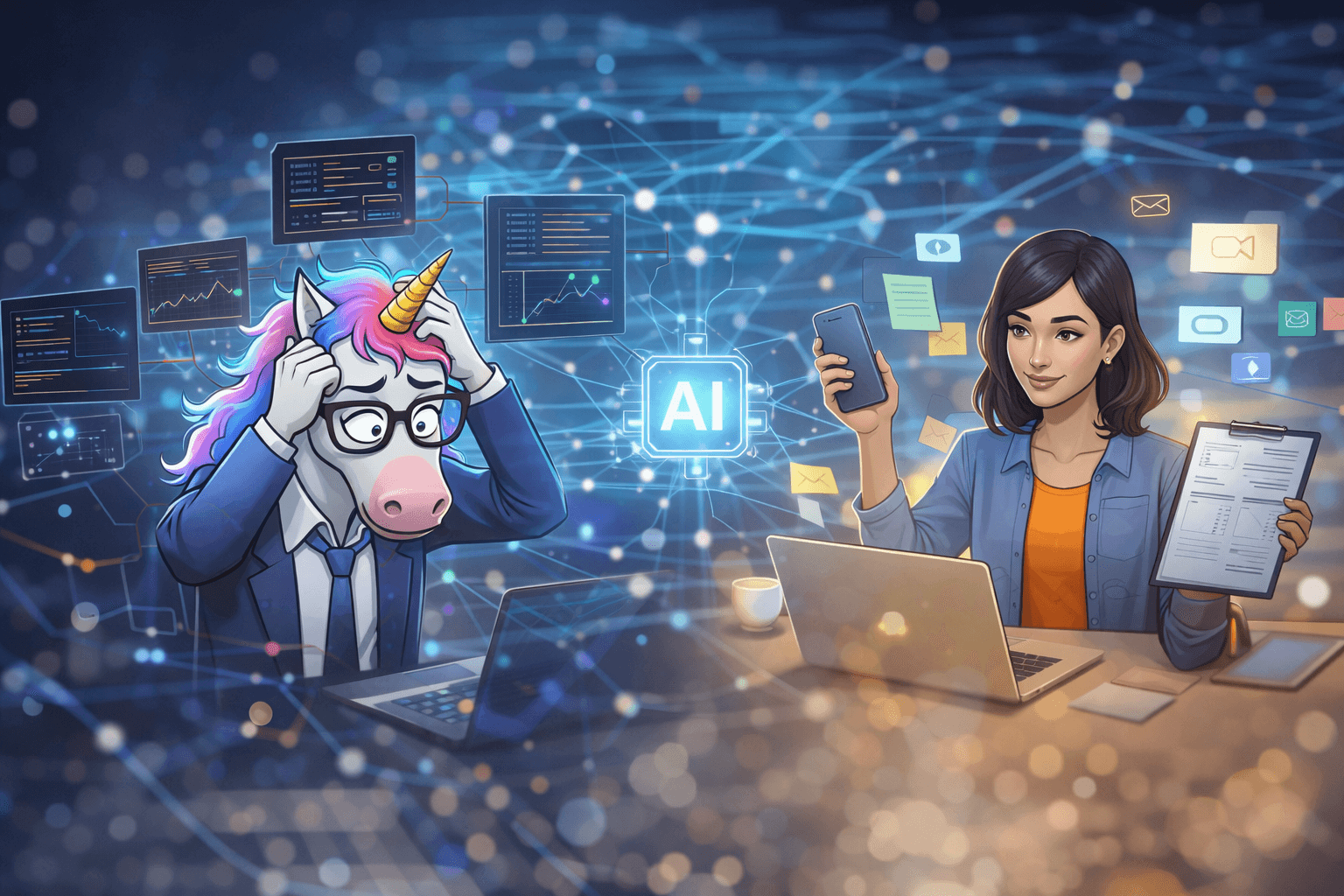
The AI generalist is no longer a fringe profile in enterprise hiring conversations. In boardrooms and sprint reviews alike, CTOs are quietly acknowledging what the market is signalling: the era of the unicorn data scientist is fading, and a more adaptive, cross-functional model is taking its place. For more than a decade, companies chased the mythical hire — the statistician who coded like a senior engineer, built production systems, crafted elegant models, and translated complex analysis into board-ready narratives. Today, the economics of AI and the rise of generative tooling are rewriting that script entirely.
The Decline of Unicorn Data Scientist Hiring
The decline in unicorn data scientist hiring is not about lowering the bar. It is about redefining what excellence looks like. In 2015, a data scientist was described as part statistician and part software engineer — a framing that made sense when model-building was the bottleneck. In 2025, model building is no longer a constraint. Generative AI tools can now scaffold code, automate exploratory analysis, and accelerate feature engineering. The friction has moved.
Today the real constraints in enterprise AI are deployment and integration, business alignment, cross-functional execution, responsible and ethical AI usage, and change management across teams. The traditional unicorn data scientist was optimised for depth across a few domains. The modern enterprise needs velocity across many. That is where the AI generalist comes in.
AI Generalist vs Specialist: A Question of Orchestration
The conversation is not about replacing specialists — it is about balance. A specialist data scientist still matters deeply in research-heavy or highly regulated environments. But most enterprises are not building frontier models. They are integrating AI into marketing workflows, supply chain systems, customer operations, and product experiences.
The distinction is subtle but powerful. Where a unicorn data scientist brings deep, research-oriented model building with variable business alignment, the AI generalist brings tool-augmented competence, central business focus, and high-speed experimentation as a core expectation — with cross-functional collaboration as essential, not optional. Specialists push boundaries. Generalists connect the dots. And in most enterprise environments, value is created in the connections.
The Rise of AI Generalists Inside Lean Teams
The rise of the AI generalist is closely tied to how companies now build products. Smaller teams are expected to ship faster. Budgets are tighter. AI is no longer a lab experiment — it is embedded in revenue models. In this environment, a hybrid data scientist who understands analytics, product thinking, and system design becomes disproportionately valuable.
A hybrid data scientist does not need to prove mathematical brilliance daily. They must be able to translate business problems into solvable AI workflows, decide when to build versus buy, integrate AI into existing systems, and communicate trade-offs clearly to non-technical leaders. This shift is part of a broader AI workforce transformation where roles are blurring — marketing teams experiment with prompt engineering, product managers run AI-enabled experiments, and engineers collaborate with copilots daily. The AI generalist thrives in this fluid environment.
Enterprise AI Team Composition in 2026 and Beyond
For CTOs, the real question is structural. A balanced three-layer model is emerging across forward-thinking enterprises. The foundation layer focuses on architecture, governance, and core platforms — staffed by senior AI specialists. The application layer handles workflow integration and experimentation — the natural home of the AI generalist. The business interface layer covers strategy, metrics, and change management — filled by cross-functional AI roles who sit between technical teams and executive leadership.
Companies are increasingly investing in fewer pure research hires and more adaptable operators who can sit between engineering and business. The role of data science in the future will be less about isolated modelling and more about embedded intelligence across workflows.
Why the AI Generalist Is a Strategic Advantage
The AI generalist brings three qualities that matter to executive teams. First, systems thinking — they understand how models, APIs, workflows, and user behaviour connect. Second, communication fluency — they can sit in a finance review in the morning and a sprint planning session in the afternoon. Third, disciplined experimentation — they know how to test, measure, iterate, and ship. These qualities generate durable value. The unicorn data scientist was often a hero contributor. The AI generalist is an amplifier — they make other teams better.
"Competitive advantage will not come from hiring a few exceptional individuals. It will come from building adaptable ecosystems of talent."
What This Means for CTOs: Practical Implications
The implications are practical. CTOs should stop writing job descriptions that search for a mythical unicorn data scientist, and start defining outcomes rather than tool stacks. Investing in internal training programmes to cultivate AI generalist capabilities, and deliberately pairing specialists with generalists, will yield more resilient and business-aligned teams.
Look closely at job postings today and you will see titles blending disciplines — Senior Machine Learning Data Scientist with deployment focus, AI Product Strategist, Platform Engineer with experimentation mandate. These are signs that cross-functional AI roles are becoming the norm. The enterprise does not need more isolated modelling capacity. It needs professionals who can move from prototype to production to measurable impact.
As tooling lowers the barrier to model development, execution discipline, cross-functional fluency, and architectural thinking become the real differentiators. The CTOs who anticipate this shift and rebalance toward the AI generalist model will see stronger velocity, better alignment with business strategy, and more resilient enterprise AI team composition over time.
Key Takeaways
- • Generative AI has removed model building as the bottleneck — the real constraints now are deployment, business alignment, and cross-functional execution.
- • The AI generalist — a business-fluent, technically grounded hybrid — is emerging as the more scalable enterprise talent model versus the traditional unicorn data scientist.
- • A three-layer team structure (foundation specialists, application generalists, business interface roles) is becoming the benchmark for forward-thinking enterprise AI teams.
- • The AI generalist's key advantages are systems thinking, communication fluency, and disciplined experimentation — making them amplifiers of other teams rather than hero contributors.
- • CTOs should rewrite job descriptions around outcomes, invest in internal AI generalist training, and intentionally pair specialists with generalists for maximum organisational impact.