
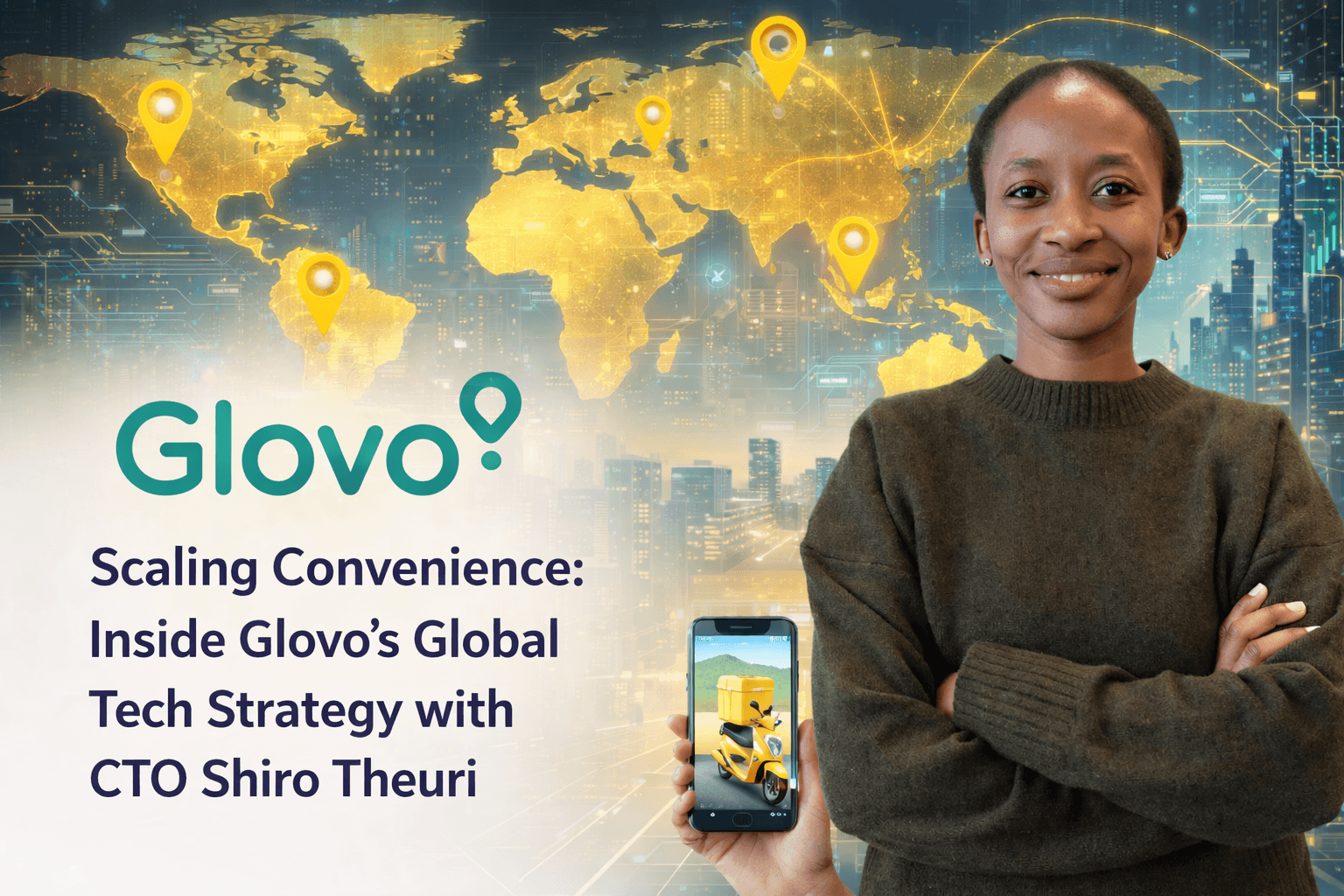
Scaling Convenience: Inside Glovo's Global Tech Strategy with CTO Shiro Theuri
AI / Machine Learning | 5 min read
The global online food delivery services market is projected to reach US$600 billion by 2033, according to Market Research Intellect. Yet as platforms scale, the complexity of managing a three-sided quick-commerce (Q-Commerce) marketplace — connecting customers, riders, and partners — grows exponentially. For Glovo, a tech platform operating across 22 countries and connecting millions of users with local restaurants, grocers, and retailers, that complexity is lived every day. At its centre is Shiro Theuri, Chief Technology Officer, who was headhunted for the role while living and working in Nairobi and now leads a global engineering organisation of 400 people. Here, she discusses AI adoption, augmented engineering, responsible innovation, diverse team-building, and what "tech with purpose" means in practice at Glovo.
Keeping a 22-Market Platform Agile and Performant
Glovo's operating model separates global infrastructure responsibility from local relationship management. As Theuri explains, the tech team's role is to provide the infrastructure that allows the platform to operate smoothly across all territories — while people on the ground in every market maintain the close relationships with partners, riders, and customers. Senior leaders, including Theuri herself, travel to local territories as needed — for example, when a new offering or payment service is being rolled out — ensuring that the global platform remains genuinely responsive to local operational realities. Gartner predicts that augmented engineering will soon save developers up to 40% of their time on routine tasks — a figure that reflects the direction Glovo is already moving in its own engineering practices.
AI Adoption: A Three-Stage Philosophy
Theuri frames Glovo's approach to AI in three stages. The first was laying the foundation — ensuring Glovo employees can harness and adopt AI in a secure, responsible, and governed way, which she describes as an important first step given the volume of noise and tooling in the market. The second is augmented engineering — AI-assisted code generation that, when done carefully and precisely, is a significant time-saver for the tech team and one she is seeing used more and more each month. The third is ongoing education, offering development teams options to explore so they can discern what is genuinely productive for Glovo versus what isn't. The role of leadership in this model is explicitly that of guardian — protecting teams while maintaining the highest possible quality of output.
"First and foremost, it's an extremely useful technology that all organisations must be utilising where most effective. Our role as leaders is to be guardians during that process, to ensure they are protected and the quality of the work is as high as possible."
— Shiro Theuri, Chief Technology Officer, Glovo
Responsible AI for Riders, Partners, and Customers
As AI becomes further embedded in Glovo's delivery logistics, responsible and equitable application for all three sides of the marketplace — riders, partners, and customers — is a leadership priority. Theuri describes this as very much on leaders within the team to discern what is and isn't a safe, responsible use of AI and to guide teams accordingly. The abundance of tools and information in the AI space, she notes, includes content that can be harmful or at the very least inaccurate — making ongoing education a continuous imperative given the rapidly shifting AI landscape. The governance layer established as Glovo's first step in AI adoption is the structural answer to this challenge: ensuring that AI is adopted systematically rather than opportunistically, with appropriate controls across the organisation.
Robotics, Drones, and the Future of Last-Mile Delivery
Glovo is actively interested in robotics and drones as last-mile delivery enablers — but Theuri is measured about the timeline, particularly in the European regulatory context. In dense urban areas, she has no doubt that drone deliveries will be able to cut delivery times, which as Q-Commerce evolves is, in her words, largely the name of the game. But in Europe, the industry is still working through how to operate in a safe, regulated way — in contrast to more advanced deployments elsewhere in the world. On robotics specifically, Theuri acknowledges that robots don't tire like human couriers, but notes they are very expensive and that at this early stage there is a lot that can go wrong. Glovo's position is clear: it will only proceed with technology that does not pose a real risk to the company and its users. Caution, not hesitation — but caution grounded in genuine responsibility toward riders and customers alike.
Building Diverse Global Engineering Teams — and Tech With Purpose
Theuri's own trajectory is itself evidence of Glovo's diversity commitment — headhunted for the role while living and working in Nairobi, she joined as a senior director managing approximately 150 people and now leads a team of 400. She describes the challenge of being accountable for the work of that many people while fostering an environment where they're encouraged to work with autonomy and creativity as a huge part of her day-to-day role — a leadership muscle she had to quickly grow when moving into the CTO position. She is a vocal advocate for women in tech and an active mentor for women building their careers in the industry. On "tech with purpose", two Glovo initiatives stand out: the rollout of micro-donations — a clear, easy mechanism within the Glovo order flow for customers to donate to a charity or foundation of their choice — and annual "impactathons", hackathons where engineers come together to brainstorm creative solutions that do good in the world.
"Glovo has always been proactive in building diverse, global teams — I was headhunted for the role whilst living and working in Nairobi, for example. I'm a big advocate for women in tech and ensure I'm an active mentor for women making their way."
— Shiro Theuri, Chief Technology Officer, Glovo
Key Takeaways
- • Glovo's CTO Shiro Theuri — headhunted from Nairobi, now leading 400 engineers across 22 markets — structures the platform around a clear division: global infrastructure from the tech team, local relationships from ground-level teams, with senior leaders travelling to territories during new offering or payment rollouts to maintain operational responsiveness.
- • Glovo's AI adoption philosophy is three-stage: (1) governed foundation — enabling all employees to use AI securely and responsibly; (2) augmented engineering — AI-assisted code generation used increasingly across the tech team; (3) ongoing education — giving developers options to explore and discern productive AI from noise, with leaders acting as guardians throughout.
- • On responsible AI for riders, partners, and customers: Theuri emphasises that the abundance of AI tools includes content that can be harmful or inaccurate — making governance and continuous education non-negotiable as AI becomes further embedded in delivery logistics across three sides of a marketplace.
- • On drones and robotics: Theuri sees clear potential for drones to cut delivery times in dense urban areas — a core Q-Commerce objective — but Europe's regulatory environment requires a cautious, safety-first approach. Robotics are promising but expensive and early-stage; Glovo will only proceed with technology that does not pose real risk to the company or its users.
- • "Tech with purpose" at Glovo takes two concrete forms: micro-donations embedded in the customer order flow (donating to a charity of choice with each order) and annual "impactathons" — hackathons where engineers collaborate on creative solutions that generate real-world positive impact beyond Glovo's commercial operations.