
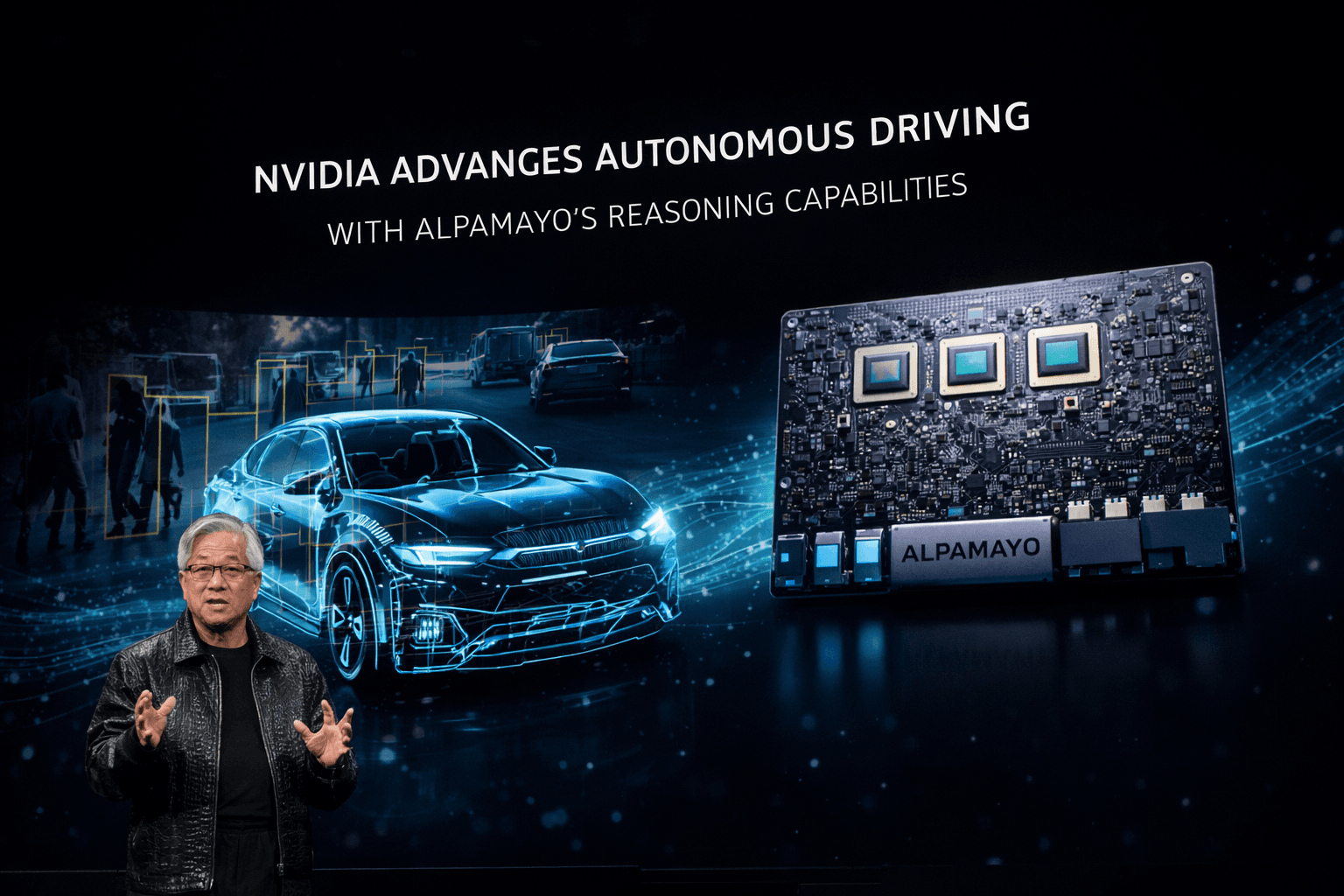
NVIDIA's Alpamayo Brings Reasoning to Self-Driving Tech
AI / Machine Learning | 5 min read
NVIDIA has unveiled Alpamayo — a family of open AI models, simulation frameworks, and datasets designed to bring human-like reasoning to autonomous vehicles (AVs). Described by NVIDIA as the world's first thinking model for self-driving technology, Alpamayo marks a fundamental shift from perception-only systems to reasoning-first autonomous driving. It was first unveiled at CES 2026 and represents NVIDIA's most ambitious step yet into physical AI.
"The ChatGPT moment for physical AI is here — when machines begin to understand, reason and act in the real world. Robotaxis are among the first to benefit. Alpamayo brings reasoning to autonomous vehicles, allowing them to think through rare scenarios, drive safely in complex environments and explain their driving decisions — it's the foundation for safe, scalable autonomy."
— Jensen Huang, Founder and CEO, NVIDIA
From Perception to Reasoning: A Fundamental Shift
Traditional autonomous vehicle systems follow a fixed pipeline — perception, prediction, planning, and control — that works well for common scenarios but degrades quickly when vehicles encounter situations outside their training data. Alpamayo was built to address this exact weakness. Rather than relying on pattern matching, it applies Vision-Language-Action (VLA) models that interpret complex driving environments, articulate the reasoning behind each decision, and support fully interpretable, auditable autonomy.
At the core is Alpamayo 1 — a 10-billion-parameter chain-of-thought, reasoning-based VLA model that processes video, ego-motion history, navigation data, and text prompt inputs, generating driving trajectories while simultaneously explaining its decisions. It is currently the most downloaded robotics model on Hugging Face and is available as fully open-source for non-commercial use.
Three Pillars: Models, Simulation, and Data
Alpamayo is not a single model but a cohesive, open ecosystem built on three integrated pillars that any automotive developer or research team can adopt:
- • Alpamayo 1 (VLA Model) — a 10B-parameter open reasoning model trained on over 80,000 hours of multi-camera driving data and 700,000 Chain-of-Causation reasoning traces, enabling step-by-step decision logic for rare and complex edge cases.
- • AlpaSim — a fully open-source, closed-loop AV simulation framework featuring realistic sensor modelling, configurable traffic behaviour, and scalable testing across millions of virtual miles across diverse weather and traffic conditions.
- • Physical AI AV Dataset — a large-scale, geographically diverse open dataset comprising over 1,700 hours of captured driving data covering a wide range of real-world scenarios, available on Hugging Face for training and evaluation.
Importantly, Alpamayo models do not run directly inside vehicles. Instead, they serve as large-scale "teacher" models — developers use them to distil and fine-tune leaner, production-ready software for deployment in actual AV stacks. The models are also compatible with NVIDIA's Cosmos generative world models, enabling synthetic data generation for training and testing at scale.
Built on the Halos Safety Architecture
Underpinning the entire Alpamayo ecosystem is NVIDIA's Halos — a full-stack safety system that combines vehicle hardware architecture, AI models, chips, software, and development tools to ensure safe and scalable AV innovation. Halos provides the safety guardrails that make Alpamayo's open, reasoning-based approach viable for real-world deployment and regulatory collaboration.
Industry Leaders Rally Behind Alpamayo
Several major mobility companies have already moved to adopt Alpamayo for their Level 4 AV programmes, including Uber, JLR, Lucid Motors, and Berkeley DeepDrive.
"Handling long-tail and unpredictable driving scenarios is one of the defining challenges of autonomy. Alpamayo creates exciting new opportunities for the industry to accelerate physical AI, improve transparency and increase safe Level 4 deployments."
— Sarfraz Maredia, Global Head of Autonomous Mobility and Delivery, Uber
"The shift toward physical AI highlights the growing need for AI systems that can reason about real-world behaviour, not just process data. Advanced simulation environments, rich datasets and reasoning models are important elements of the evolution."
— Kai Stepper, VP of ADAS and Autonomous Driving, Lucid Motors
"Open, transparent AI development is essential to advancing autonomous mobility responsibly. By open-sourcing models like Alpamayo, NVIDIA is helping to accelerate innovation across the autonomous driving ecosystem, giving developers and researchers new tools to tackle the hardest problems in autonomy."
— Thomas Müller, Executive Director of Product Engineering, JLR
Why Openness Is the Strategy
Most commercial autonomous driving systems are closed and proprietary. Alpamayo intentionally takes an open-source approach — a strategy that mirrors how open frameworks accelerated both deep learning and large language model research. By standardising foundational autonomy components, Alpamayo lowers the barrier for OEMs, Tier 1 suppliers, startups, and researchers to work on AV development — reducing duplicated effort and aligning the ecosystem around shared safety standards and regional regulatory requirements.
Key Takeaways
- • NVIDIA Alpamayo is the world's first open reasoning model family for autonomous vehicles, unveiled at CES 2026.
- • At its core is Alpamayo 1, a 10B-parameter VLA model trained on 80,000+ hours of driving data and 700,000 Chain-of-Causation reasoning traces.
- • The ecosystem includes AlpaSim (open-source simulation) and a 1,700+ hour Physical AI dataset — all available on Hugging Face.
- • Industry partners including Uber, JLR, Lucid Motors, and Berkeley DeepDrive are already building on the platform for Level 4 autonomy.
- • Alpamayo's open-source strategy signals a new era in physical AI — where transparent, explainable decision-making becomes the foundation for safe autonomous systems. Learn more at nvidia.com/alpamayo.