
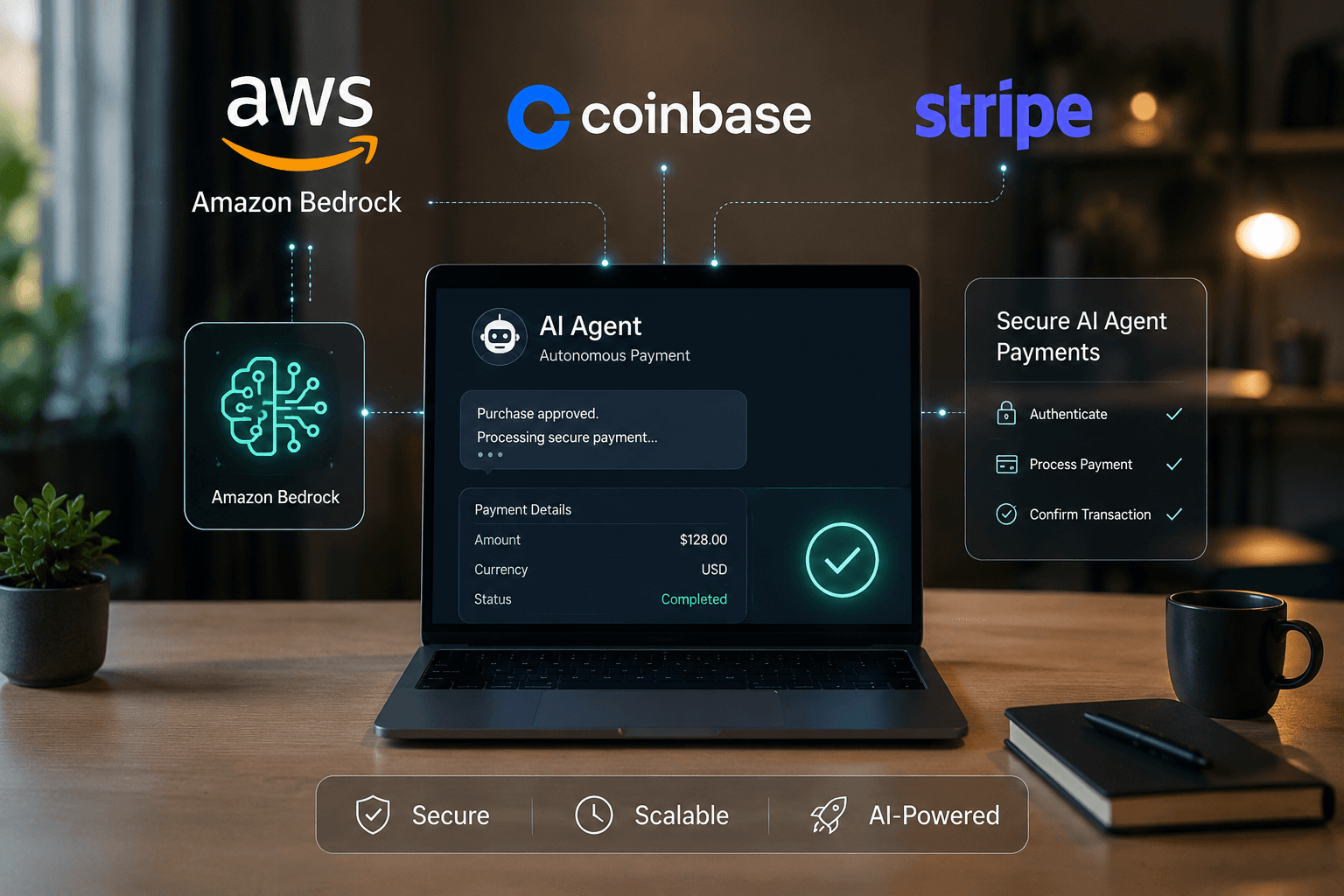
A new chapter in the story of artificial intelligence has quietly opened — one in which AI agents don't just answer questions or complete tasks, but spend money independently on your behalf. Amazon Web Services has unveiled Amazon Bedrock AgentCore Payments, the first fully managed payment infrastructure purpose-built for autonomous AI agents — developed in partnership with Coinbase and Stripe. The launch signals the arrival of an "agentic economy" where AI is not merely a tool, but an independent economic actor.
What Is Amazon Bedrock AgentCore Payments?
Amazon Bedrock AgentCore Payments is a new set of features within Amazon Bedrock that enables AI agents to autonomously discover, access, and pay for digital resources — including APIs, web content, MCP servers, data feeds, and even other AI agents — all within a single execution loop, without any manual billing integration required.
Until now, developers building AI agents had to manually wire up payment integrations, manage credentials, handle billing relationships, and build spending controls for every third-party service their agent might need. AgentCore Payments eliminates that overhead entirely, abstracting the payment layer into a unified developer experience. When an agent encounters a paid resource, the platform handles protocol negotiation and payment delivery automatically — without interrupting the agent's reasoning loop.
The platform is currently available in preview in Northern Virginia, Oregon, Frankfurt, and Sydney.
The Technology Stack: Coinbase x402, Stablecoins & Stripe Privy
The payment infrastructure at the heart of AgentCore Payments is built on two complementary systems. Coinbase's x402 protocol — an open, HTTP-native payment standard based on the HTTP 402 "Payment Required" response code — powers machine-to-machine stablecoin transactions using USDC on Ethereum Layer-2 network Base and Solana. Transactions settle in approximately 200 milliseconds, making true micropayments at fractions of a cent commercially viable for the first time.
Stripe's Privy wallet provides a parallel payment connection at preview, giving developers immediate access to Stripe's global payment infrastructure. The two providers represent different but complementary theories of how agent commerce will ultimately settle — Coinbase's crypto-native stablecoin rails alongside Stripe's traditional fiat payment capabilities. Both paths are supported, with AWS confirming plans to expand fiat payment support as the platform matures.
To discover paid services, agents can draw on the Coinbase x402 Bazaar MCP server — a curated, searchable catalogue of x402-compatible endpoints integrated directly into the AgentCore gateway. The x402 protocol has already processed over 169 million machine-native payments across 590,000 buyers and 100,000 sellers.
"There will soon be more AI agents transacting than humans, and they need money that's built for the internet — programmable, always on, and global."— Brian Foster, Head of Infrastructure Growth & Strategy, Coinbase
Safety, Spending Controls & Enterprise Compliance
A critical concern with any autonomous spending system is control. AgentCore Payments addresses this directly: agents never have open-ended access to funds. Instead, end users connect either a Coinbase wallet or a Stripe Privy wallet as the funding source, fund it with stablecoins or fiat via debit/credit card, and set strict session-based spending limits. The agent operates only within those explicitly authorised boundaries.
Critically, agents do not receive access to private keys at any point. The system handles wallet authentication, transaction signing, and payment through a single API call, while providing comprehensive compliance controls, transaction logs, metrics, and dashboards across the full payment lifecycle. Every transaction is tracked via standard logs in the AgentCore console.
This design directly targets the most common barrier to enterprise adoption of autonomous AI systems — not technical capability, but legal review, audit requirements, and budget governance. By wrapping crypto payments inside familiar enterprise controls, AWS is making the model far easier for large organisations to test in production.
Early Adopters: Real-World Use Cases Already in Motion
Among the first companies building on AgentCore Payments is Heurist AI, a full-stack infrastructure provider for the AI economy. The company is using the platform to power a research agent that performs financial and cryptocurrency analysis on behalf of end users. Customers set a budget for each research session; the agent then uses AgentCore Payments to autonomously access accurate real-time market data, social sentiment signals, and news feeds.
"We were able to integrate payments quickly to our agent with low effort and few lines of code."— JW Wang, Founder, Heurist AI
A Broader Race: The Emerging AI Payments Landscape
AWS is not alone in building for the agentic economy, and the company's choice of Coinbase and Stripe is itself a strategic signal. Both companies share something the major banks and card networks do not: deep developer trust and adoption. The agent economy is being built by software engineers, and those engineers already rely on Stripe and Coinbase in their day-to-day work.
The platform is protocol-agnostic by design. While x402 is the first supported standard at launch, competing protocols are already entering the market — including Google's AP2 and Tempo's Machine Payments Protocol. Visa has also unveiled its Intelligent Commerce Connect to help merchants accept agent-initiated transactions. AWS has confirmed plans to support additional payment protocols in future iterations, positioning AgentCore as a neutral hub for agentic commerce rather than a single-protocol walled garden.
If AI agents do become mainstream economic actors, stablecoins like USDC could quietly evolve into the default payment layer powering millions of automated online transactions every single day — embedded not in consumer wallets, but in enterprise software stacks.
"For agents to become meaningful economic actors, they need a way to hold and spend money. That's why we're excited to partner with AWS to make stablecoin wallets for agents readily available to AgentCore developers."— Henri Stern, CEO of Privy, a Stripe company