
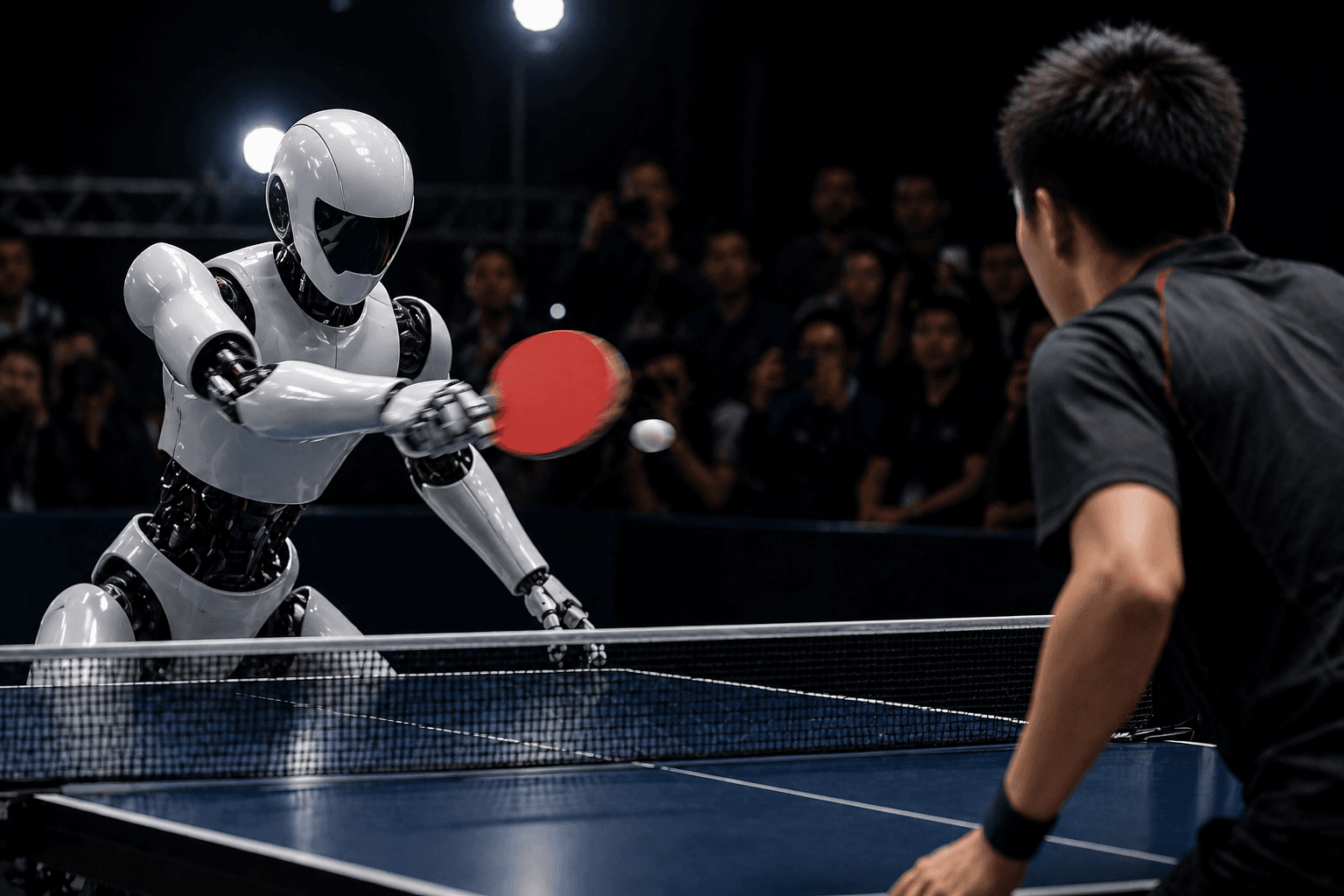
Sony AI's Project Ace Robot Beats Elite Table Tennis Players — A Landmark Moment for Physical AI and Real-World Autonomous Systems
AI / Machine Learning | 4 min read
Sony AI has published research in Nature describing Ace — to the researchers' knowledge, the first real-world autonomous robot capable of competing with and defeating elite human table tennis players under official competition rules. The paper, published 22 April 2026, documents five years of development at Sony AI's Zürich laboratory — beginning in 2020 with a robot that could barely keep the ball in play and culminating in a system that won three matches out of five against elite amateur players (players with 10+ years of intensive experience averaging 20 hours of practice per week) and, in March 2026 trials, defeated three separate professional players at least once each. Ace combines high-speed event-based vision sensors, a deep reinforcement learning control system trained entirely in simulation, and a custom-built eight-degree-of-freedom robotic arm — achieving an end-to-end latency of 20.2 milliseconds, compared to roughly 230 milliseconds for elite human players.
"This research has shown that an autonomous robot can, in fact, win at a competitive sport, matching or exceeding the reaction time and decision making of humans in a physical space. Table tennis is a game of enormous complexity that requires split-second decisions as well as speed and power. This research breakthrough highlights the potential of physical AI agents to perform real-time interactive tasks, and represents a significant step toward creating robots with broader applications in fast, precise and real-time human interactions."
— Peter Dürr, Director, Sony AI Zürich and Project Lead for Ace
How Ace Works — Event-Based Vision, Reinforcement Learning, and Spin Detection
Ace is built around three integrated systems. Its perception system uses nine active pixel sensor cameras (Sony IMX273) that locate the ball in three-dimensional space at 200 Hz with 3.0 mm error and 10.2 ms latency, alongside three gaze control systems using event-based vision sensor cameras (Sony IMX636) to measure ball spin — the decisive factor in professional table tennis. Previous table tennis robots consistently failed to account for spin; Ace successfully returned 75% of spinning balls across a wide range of spin types. Its AI control system uses deep reinforcement learning — trained entirely in simulation through a privileged-critic architecture — and transfers seamlessly to real-world play, producing shot variations and adaptive rally behaviour. The system makes decisions in the moment rather than relying on pre-programmed presets, blending skill (striking the ball cleanly), tactics (striking safely or aggressively), and strategy (how decisions accumulate across a match). Finally, its robotic hardware — a custom eight-degree-of-freedom arm manufactured in optimised lightweight alloys — can return balls at linear velocities of up to 19.6 metres per second, providing the speed needed for professional-level rallies and competitive serves. Ace is a stationary system designed exclusively for table tennis — not a humanoid robot.
"This breakthrough is much bigger than table tennis. It represents a landmark moment in AI research, showing, for the first time, that an AI system can perceive, reason, and act effectively in complex, rapidly changing real-world environments that demand precision and speed. Once AI can operate at an expert human level under these conditions, it opens the door to an entirely new class of real-world applications that were previously out of reach."
— Peter Stone, Chief Scientist, Sony AI
The Match Results — and Why Table Tennis Is a Unique Test for Physical AI
In the April 2025 evaluation, Ace played 13 games against five elite amateur players and won seven, securing three match wins from five. Against two professional Japanese T.League players — Minami Ando and Kakeru Sone — Ace won one game out of seven but lost both matches. In March 2026 trials, following hardware and algorithm improvements, Ace defeated three separate professional players at least once each. The victories did not come through power: Ace scored points through masterful placement and spin consistency, extending rallies until the human player erred. Table tennis is uniquely challenging for physical AI because the ball travels at high velocity with complex spin, opponents adapt adversarially in real time, the playing space imposes physical constraints, and every response must be executed within milliseconds. Sony AI chief scientist Peter Stone draws an explicit comparison with Deep Blue — the IBM chess computer that defeated Garry Kasparov in 1997 — as a reference point for what a moment of AI surpassing human expert performance in a demanding domain signifies. The Ace research builds on Sony AI's earlier breakthrough with Gran Turismo Sophy, which mastered high-speed strategy in the simulated environment of Gran Turismo — now extending the same reinforcement learning philosophy into the physical, unpredictable world.
Key Takeaways
- • Sony AI (Zürich laboratory; Project Director Peter Dürr; Chief Scientist Peter Stone) has published research describing Ace — the first real-world autonomous robot competitive with elite human table tennis players — in Nature (published 22 April 2026). Five-year development (began 2020). Research conducted under official International Table Tennis Federation (ITTF) rules. Results: three match wins from five against elite amateurs (April 2025); defeated three separate professional players at least once each (March 2026 trials).
- • Ace architecture — three integrated systems: (1) Perception: nine active pixel sensor cameras (Sony IMX273) — 3D ball location at 200 Hz, 3.0 mm error, 10.2 ms latency; three gaze control systems using event-based vision sensors (Sony IMX636) for ball spin measurement. (2) AI control: deep reinforcement learning — privileged-critic architecture; trained entirely in simulation; transfers seamlessly to real-world play; adaptive shot selection combining skill + tactics + strategy. (3) Hardware: custom 8-degree-of-freedom robotic arm; optimised lightweight alloys; returns balls up to 19.6 m/s. End-to-end latency: 20.2 ms vs ~230 ms for elite human players.
- • Performance detail: won 7 of 13 games (3 of 5 matches) against elite amateurs — players with 10+ years intensive experience, averaging 20 hours/week. Against two professional Japanese T.League players (Minami Ando and Kakeru Sone): won 1 of 7 games, lost both matches. March 2026: defeated three separate professional players at least once each. Key differentiator: spin detection — 75% successful returns of spinning balls across a wide range of spin types. Victories came through placement consistency and spin mastery, not power. The robot scored by extending rallies until human players erred.
- • Why this matters — physical AI in the real world: table tennis is a uniquely demanding test for physical AI because it requires high-speed perception, real-time adaptive decision-making, adversarial human interaction, and millisecond-precise execution — simultaneously and under physical constraints. Previous AI systems dominated board games (Deep Blue vs Kasparov), video games (AlphaGo, Sophy in Gran Turismo), and simulated environments. Ace is the first to demonstrate expert-level performance in a fast, precise, adversarial physical sport under real-world conditions. Peter Stone explicitly compares Ace to Deep Blue as a category-defining moment.
- • Broader implications: Peter Stone's framing captures why this extends far beyond sport — "once AI can operate at an expert human level under these conditions, it opens the door to an entirely new class of real-world applications that were previously out of reach." The capabilities that enabled Ace — sub-20ms latency perception, spin-aware physical reasoning, RL-trained adaptive control transferring from simulation to reality — are precisely the capabilities required for robotics in unstructured real-world environments: surgical assistance, manufacturing quality control, logistics sorting, human-robot physical collaboration. Ace is still not at world champion level. But it has crossed the threshold from controlled lab performance to competitive expert performance in an uncontrolled, adversarial physical environment.