
BMW: From AI Experimentation to AI Embedded in All Areas
| 6 min read
The debate over whether the AI bubble will burst continues to occupy market analysts — but for one of the world's most iconic automotive manufacturers, the technology is viewed as a definitive long-term pillar of industrial survival. BMW Group is moving decisively from scattered AI experimentation to a Group-wide AI platform that integrates custom generative models, multi-agent systems, and Physical AI across its entire value chain — from procurement and engineering to production floors and customer communications.
Hundreds of Use Cases, One Strategic Direction
BMW Group currently deploys AI across over 600 use cases in production alone — spanning quality control, intralogistics, ergonomics analysis, digital twins, and supply chain optimization. Leadership is not speaking in cautious terms: the company's prediction is that in the foreseeable future, every process at BMW Group will be AI-supported.
"We're scaling artificial intelligence along the value chain, from development and production through to sales. In the foreseeable future, every process at the BMW Group will be AI-supported. We already have hundreds of use cases in series production today."
— Marco Gorgmaier, VP Enterprise Platforms and Services, Data, AI, BMW Group
The primary drivers behind the push are efficiency, innovation, and a rigorous focus on return on investment (ROI). Rather than treating AI as a technology to be trialled in isolated pockets, the company has built the infrastructure to deploy it at enterprise scale — with a unified data platform replacing siloed data structures and enabling AI agents to operate autonomously across complex operational environments.
The Virtual Factory and iFACTORY Strategy
At the heart of the manufacturing transformation is the Virtual Factory — a comprehensive digital twin ecosystem now being scaled across BMW's 30+ global production sites as a core element of its broader iFACTORY strategy. The virtual factory embeds digital twin use into every phase of planning and validation, enabling AI to do work that once required physical prototyping and manual testing.
Practical applications already in series production include virtual collision checks — where AI simulates new vehicle model movement through every segment of the production line to ensure fit, safety, and accessibility without halting operations — as well as AI-driven layout and flow optimization that adjusts robot positioning, conveyor flows, and logistics sequences in real time. Human simulation and ergonomics AI evaluates manual assembly steps, improving worker safety before any physical rollout. More than 40 vehicle integrations are planned to be handled virtually by 2027.
Physical AI: Humanoid Robots on the Production Floor
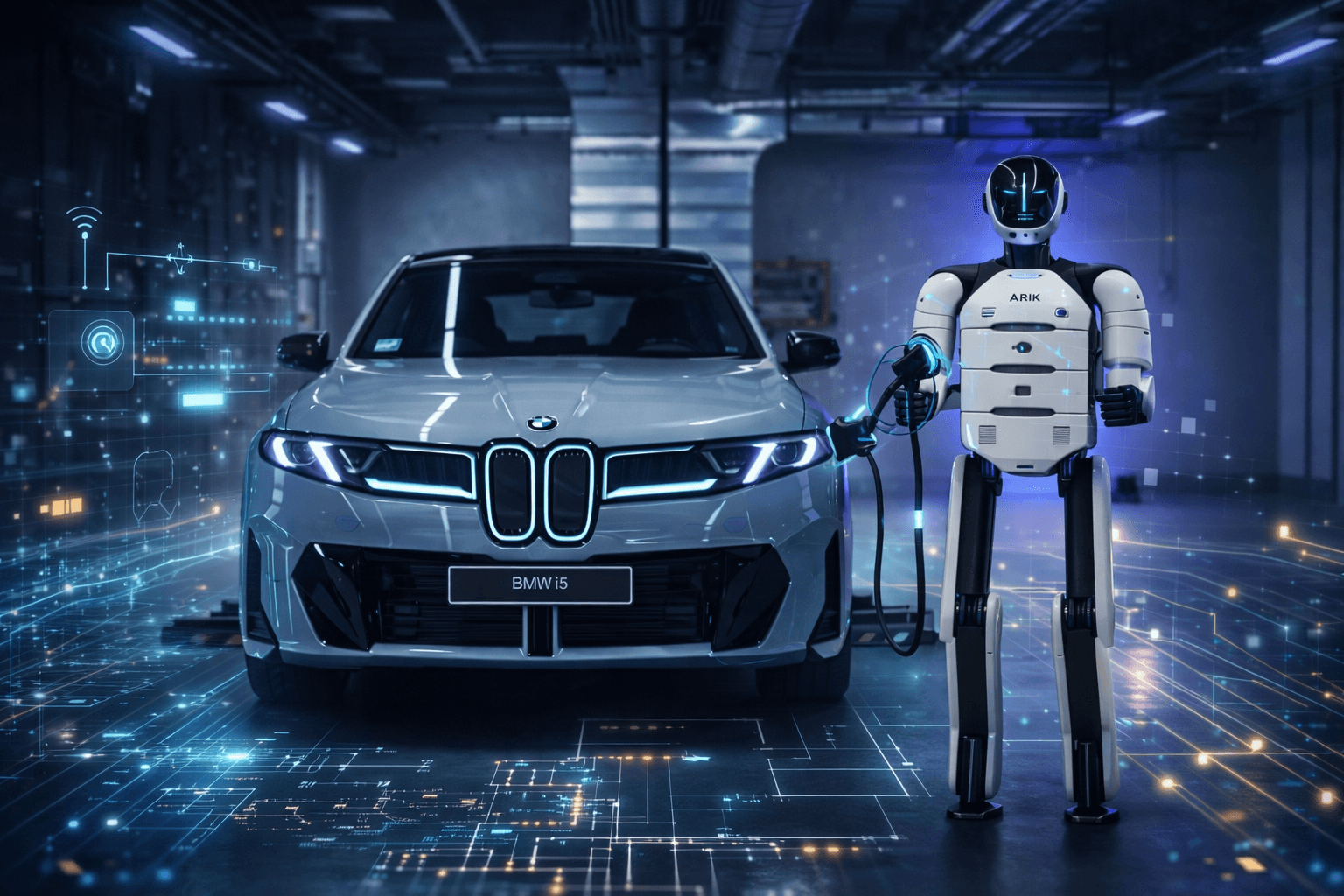
In 2026, the company has pushed beyond software-only AI into the domain of Physical AI — the symbiosis of digital intelligence and mechanical hardware. This includes the deployment of humanoid robots in production environments through the AEON project at the Leipzig plant, conducted in partnership with Hexagon's robotics unit. After lab validation and initial on-site testing, a broader pilot phase is scheduled to begin in summer 2026, with a focus on high-voltage battery assembly and component manufacturing — areas where precision, safety, and ergonomics are all critical.
These systems learn from real-world production data and are integrated into existing series manufacturing — not deployed as standalone experiments. The company has also established a dedicated Centre of Competence for Physical AI in Production to standardise evaluation criteria and scale deployments systematically across its global manufacturing network. According to BMW's head of process management, humanoids could eventually allow the company to bring production work currently handled by suppliers back in-house.
"We are now entering the next chapter: scaling AI across our organisation to unlock new levels of efficiency and to empower smarter, faster and more forward-looking decision-making."
— Dr Nicolai Martin, Member of the Board of Management, BMW AG, Purchasing and Supplier Network
Multi-Agent AI in Engineering and Development
One of the most striking demonstrations of BMW's AI maturity is its deployment of multi-agent AI systems in vehicle engineering. In partnership with Microsoft Azure, the company has built a multi-agentic architecture that accelerates test-fleet data analysis by twelvefold. Each development vehicle in a fleet of several thousand generates between 5 and 10 terabytes of measurement data every week — braking patterns, torque, RPMs, battery voltage, and thousands of additional parameters.
The multi-agent system automatically connects to multiple specialized agents to acquire, pre-analyze, and visualize results from measurement data repositories in development vehicles. What previously represented a data overload challenge is being transformed into a living asset — one that learns, adapts, and drives innovation across every vehicle BMW builds. BMW plans to extend this multi-agent orchestration beyond test fleets into powertrain, software-integration, and validation programs, further scaling the model across its engineering landscape.
AI in Procurement: The AIconic Multi-Agent System
The AI transformation extends into procurement operations through the AIconic multi-agent system — a centralised chat interface that incorporates the Tender Assistant and the Offer Analyst. The Tender Assistant supports procurement teams in creating high-quality tender documents by selecting appropriate templates and drawing on best practices extracted from previous successful tenders.
"At the BMW Group Purchasing Division, digitalisation and artificial intelligence are no longer just future topics — they are part of our daily reality."
— Dr Nicolai Martin, Member of the Board of Management, BMW AG, Purchasing and Supplier Network
Catena-X and Carbon Transparency Across the Supply Chain
Fully operational as of early 2026, Catena-X enables BMW and partners across its value chain to address resilience and sustainability through secure, standardised data exchange. The platform allows the precise calculation of product carbon footprints — tracing emissions from raw material extraction all the way through to the final product.
A benchmark demonstration involves the BMW iX kidney grille produced in Landshut — where Catena-X makes it possible to calculate a granular carbon footprint across the entire supply chain. For technology and sustainability leaders, the integration of AI with such ecosystems is transformative: enabling earlier risk identification, more efficient resource use, and compliance-grade emissions traceability at the component level.
What This Means for the Industry
BMW's AI journey is not just a technology story — it is a signal to the entire automotive industry. By blending engineering heritage with end-to-end AI integration — from virtual factory planning and AI-accelerated vehicle development, to intelligent manufacturing, connected cloud platforms, and personalised customer experiences — the company is establishing a new competitive baseline that rivals must now match.
The convergence of digital twins, generative AI, multi-agent systems, and Physical AI points toward factories that increasingly optimize themselves. As BMW's own leadership has signalled, the question for the industry is no longer whether to embed AI across the enterprise — it is how quickly organizations can close the gap with those that already have.
Key Takeaways
- BMW Group operates over 600 AI use cases in production and is targeting AI support for every business process across the organisation.
- The Virtual Factory and iFACTORY strategy scale digital twins across 30+ global sites, with 40+ vehicle integrations planned virtually by 2027.
- The AEON humanoid robot pilot at Leipzig targets high-voltage battery assembly, with a full-scale rollout scheduled for summer 2026.
- Multi-agent AI in partnership with Microsoft Azure delivers a twelvefold improvement in test-fleet data analysis speed.
- Catena-X, fully live in 2026, enables granular product carbon footprint tracking across the entire supply chain from raw material to final product.