
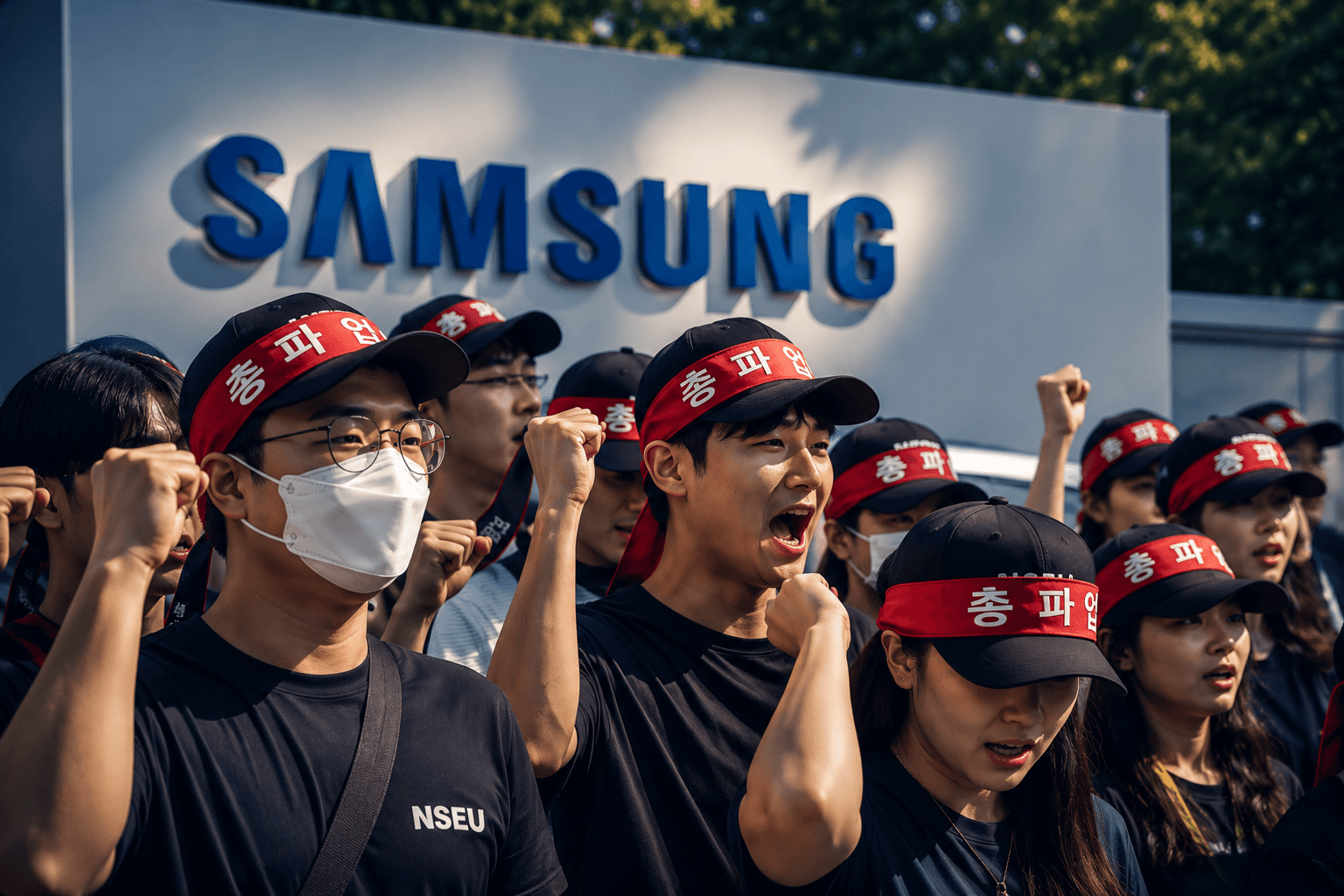
A labour dispute at Samsung Electronics — the world's largest memory chipmaker — is sending shockwaves through the global semiconductor industry. With nearly 48,000 unionised workers walking off production lines for 18 days starting 21 May, the strike represents the largest work stoppage in the history of the semiconductor industry, and its timing couldn't be worse for an AI ecosystem already starving for silicon.
The Scale of the Walkout
The planned strike involves approximately 38% of Samsung's entire domestic workforce in South Korea, making it a historically unprecedented labour action for the global chip industry. Workers began the 18-day walkout on 21 May at factories responsible for producing the majority of the company's DRAM and NAND flash memory output.
The action follows the collapse of wage negotiations, with marathon mediation sessions held under the supervision of the South Korean government ultimately failing to bridge the gap between management and union demands. Government officials applied significant pressure on the union, given that Samsung accounts for nearly a quarter of the country's total exports.
In preparation for the walkout, Samsung initiated warm-down procedures to scale back wafer inputs and protect machinery. A full 18-day shutdown means the company will be forced to scrap ultra-sensitive silicon wafers that cost as much as US$20,000 each — a staggering direct financial cost on top of the broader supply chain disruption.
How Much Supply Is at Risk?
According to Jeff Kim, analyst at KB Securities, the strike could remove between 3% and 4% of global DRAM supply from circulation, while NAND flash memory supplies could decline by an additional 2% to 3%. In a market already running at record-low fulfilment rates, even a small supply shock carries outsized consequences.
Samsung commands a 36% share of the global DRAM market. Together with rival SK Hynix, the two South Korean giants control approximately two-thirds of the world's DRAM supply. Add US-based Micron Technology and you have the only three companies on the planet producing high-bandwidth memory (HBM) at commercial scale — chips that modern AI systems simply cannot function without.
The American Chamber of Commerce in Korea has warned that significant operational uncertainty at Samsung could intensify global semiconductor supply bottlenecks, increase procurement volatility, and create broader instability throughout the electronics supply chain.
"Significant shortages across memory products are expected to continue through at least 2027."— Kim Jaejune, Memory Chief, Samsung Electronics
AI's Role in the Pressure Cooker
The strike threat lands at the worst possible moment for a semiconductor market already under extreme stress. Global technology giants from Google to Amazon are competing aggressively for cutting-edge AI processors to expand data centres and train next-generation AI models. Once considered a low-margin commodity, memory chips have become indispensable components of AI infrastructure.
DRAM contract prices have already surged 90 to 95 percent quarter-over-quarter in Q1 2026, with research firm TrendForce projecting a further 58 to 63 percent increase in Q2. Research firm SemiAnalysis expects memory chip prices to more than double by the end of 2026 compared with 2025. According to analysts at Bank of America, the resulting shortage could persist as far as 2028.
Samsung's own memory division has already acknowledged the severity of the situation, with demand fulfilment rates at record lows as customers pull forward orders for 2027 out of concern about future availability. The company's sixth-generation HBM4 chip, designed for the NVIDIA Vera Rubin platform and now in mass production, is already being reserved years in advance.
Cascading Effects on Consumer Electronics
The ripple effects are already moving beyond AI servers and data centres. As manufacturers divert wafer capacity toward high-margin AI memory, supply of conventional DRAM used in phones, laptops, and consumer electronics has contracted sharply. Global electronics makers are forecasting price increases of 5% to 20% across product categories in 2026.
Analysts at IDC and Counterpoint now expect global smartphone shipments to shrink by at least 2% in 2026, reversing earlier growth forecasts, while the PC market is projected to contract by nearly 5% after growing 8.1% the year before. Any further disruption caused by the Samsung strike would accelerate these already-concerning trends for consumer technology buyers.