
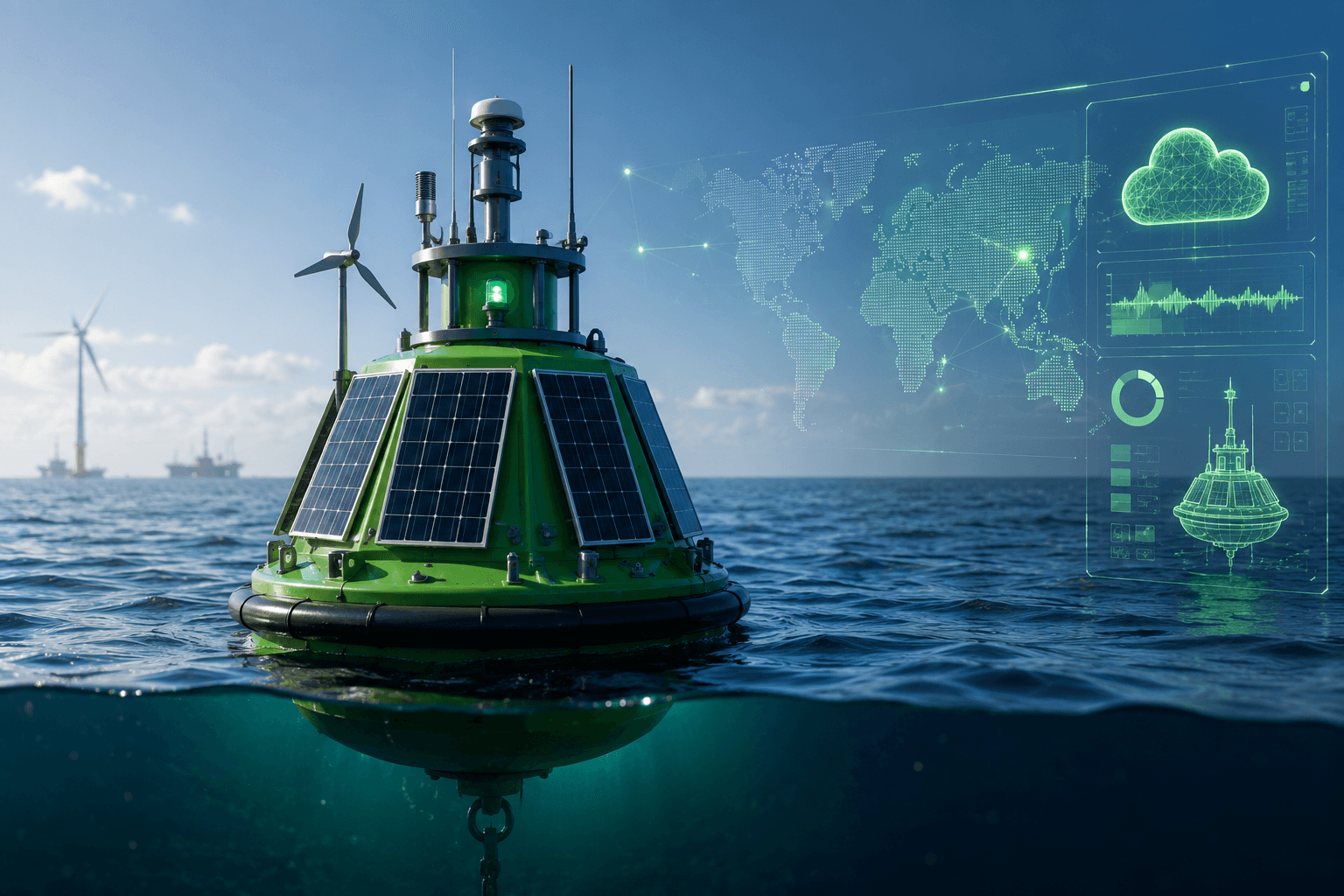
A floating buoy in the North Sea is generating its own power, managing its own systems and running without a single crew member onboard. Developed by Schneider Electric and Bilfinger, the autonomous installation has logged 1,000 hours of uninterrupted operation since its October 2025 deployment, combining renewable microgrid power, open software-defined control and Starlink connectivity to challenge the traditional reliance on umbilical-tethered offshore infrastructure.
Autonomous Systems in Extreme Environments
The project centres on a Normally Unmanned Installation (NUI), a class of offshore asset built to run without a permanent crew. These systems have to be both sophisticated and durable, engineered to withstand harsh marine conditions around the clock.
Bilfinger was appointed by Buoyant Production Technologies, a subsidiary of Crondall Energy, to design a system capable of supporting autonomous operations in remote locations. It addresses a challenge that spans well beyond oil and gas: how to manage critical assets where a permanent human presence is impractical or simply too costly.
The buoy offers an alternative for remote sites that cannot justify the infrastructure spend of a traditional manned installation, and its autonomous capabilities could serve as a template for remote monitoring, research stations and distributed infrastructure networks elsewhere.
Open Architecture and Software-Defined Control
The control system runs on Schneider Electric's EcoStruxure Automation Expert platform, an open, software-defined foundation that means the buoy's applications aren't locked to specific hardware — equipment from different vendors can be combined on the same system.
At its core sits a Modicon M580 dPAC controller, a programmable automation controller that manages the buoy's functions and the flow of data between sensors and equipment. This open architecture approach marks a shift away from proprietary systems and toward more flexible, interoperable industrial platforms.
Power comes from a renewable energy microgrid combining wind, solar PV and battery storage, with diesel generation kept as backup — a hybrid model that could inform distributed energy systems well beyond offshore energy.
Remote Monitoring and Security Systems
With no crew onboard, connectivity and safety systems carry particular weight. The buoy relies on 5G and SpaceX's Starlink for high-availability communications back to shore, demonstrating how satellite internet is enabling new approaches to unmanned offshore operations.
Fire, gas and smoke detection systems are built in, alongside what Schneider Electric describes as a layered cybersecurity framework protecting the control system from intrusion. As autonomous systems spread across industries, pairing physical safety with cyber defences could become a standard requirement rather than an added extra.
"Traditional automation architectures make customisation very difficult, especially for first-of-its-kind projects."— Steven Parkinson, Automation, Production and Service Director for the UK, Bilfinger