
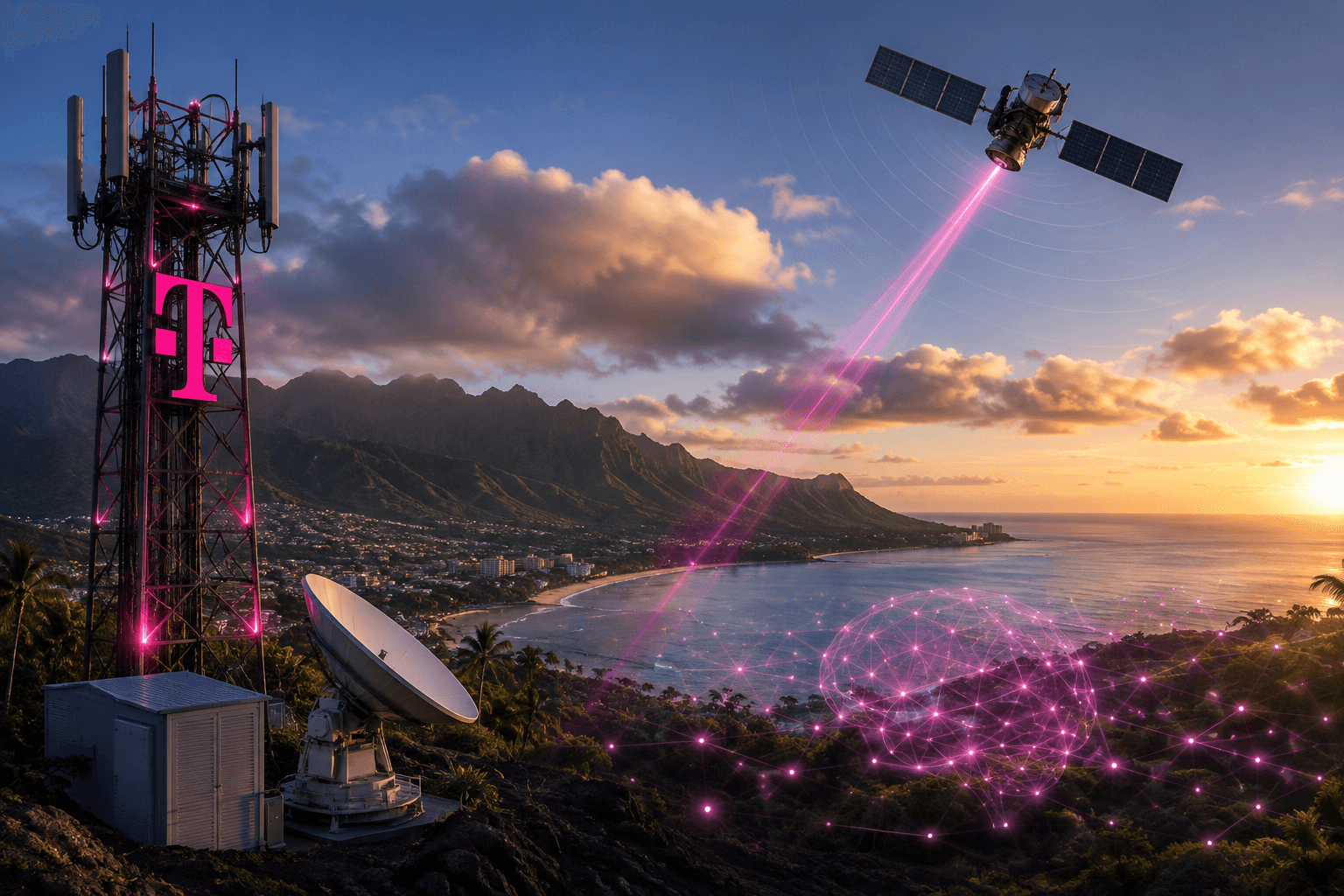
As Hurricane Lala battered Hawaii with winds of 91mph before weakening into a tropical storm, T-Mobile combined field crews and next-generation technology to keep critical communication lines open. Ground teams pre-staged generators and backup power, while the carrier activated T-Satellite powered by Starlink and an AI-driven network platform to hold the islands together when terrestrial towers went down.
Staging for the Storm
Before Hurricane Lala made landfall on 12 August, T-Mobile moved to protect connectivity across Hawaii. The company staged emergency response teams, portable generators and backup power equipment in key zones ahead of the storm's arrival, anticipating that terrestrial cell sites would take a hit as the storm intensified.
As the storm's impact reached ground infrastructure, the carrier turned to its newest layer of disaster resilience: satellite-based connectivity designed to keep phones online even when local towers fail.
A Satellite Lifeline When Towers Go Down
T-Mobile's Direct-to-Cell technology, built in partnership with Starlink, lets standard, compatible smartphones connect straight to satellites when ground networks are knocked offline — no special hardware required.
By Sunday afternoon, customers had already exchanged nearly 29,000 text messages over satellite, using the service to reach loved ones, receive Wireless Emergency Alerts and access Text-to-911. T-Mobile noted the same technology proved critical during the Southern California wildfires in January 2025, underscoring its growing role as a backstop during major disasters.
"We've built a network with real-time AI-driven optimisation that can adapt instantly."— JOHN SAW, CHIEF TECHNOLOGY OFFICER, T-MOBILE
Smart Automation in Action
Behind the scenes, an autonomous system managed the network on the ground. T-Mobile's Self-Optimizing Network (SON) — an AI-driven platform that functions like an automated air-traffic controller for cell signals — executed more than 160 real-time adjustments as the storm hit.
By continuously monitoring signal congestion and shifting coverage parameters, the AI rerouted traffic to keep connections stable even as local infrastructure sustained damage — a level of responsiveness that would be difficult for human engineers to match in real time.