
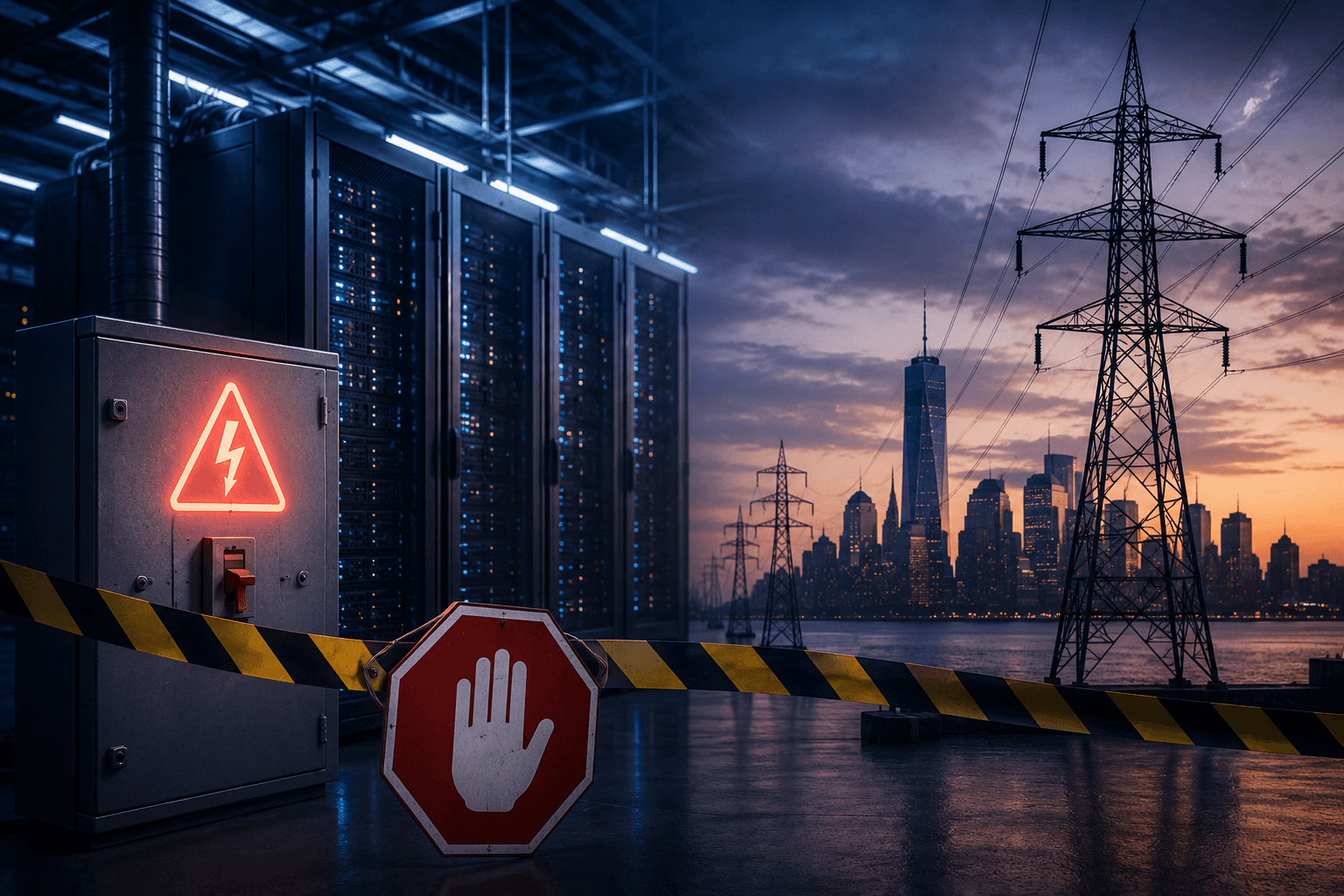
The AI boom has run headlong into the limits of the power grid. New York has become the first US state to formally pause development of hyperscale data centres, halting new facilities that draw 50MW or more of power for up to a year while regulators study the strain this scale of computing puts on electricity, water and air quality.
A Landmark Executive Order
New York Governor Kathy Hochul signed the order on 14 July, setting out to build a comprehensive environmental regulatory framework for large-scale data infrastructure.
Although the freeze technically applies to any commercial data storage facility of this size, it was overwhelmingly driven by the runaway power demands of the generative AI boom. During the pause, state officials will draft a Generic Environmental Impact Statement assessing how these facilities affect regional power grids, water reserves and air quality.
While the policy is local, its implications reach far beyond New York. It signals to the wider tech sector that the age of unchecked digital infrastructure expansion is coming to an end, and offers a preview of how governments elsewhere may choose to manage, tax and regulate the physical footprint of the AI era.
"These hyperscale AI data centres consume enormous amounts of power"— Kathy Hochul, Governor, New York State
Why New York Pulled the Brakes
Conventional data centres draw a fairly steady, predictable baseline of electricity. AI infrastructure behaves very differently: training foundation models can create multi-week spikes in demand, which then swing to highly variable levels once systems move into live deployment.
That volatility is catching utility providers off guard. According to Capgemini's report AI meets the grid: shaping the data center power play, 77% of utilities are struggling to forecast the energy demand created by the expansion of AI-driven data centres.
Capgemini also projects that electricity consumption from AI training and inference will climb from roughly a quarter to 60% of total data centre power demand within the next three to five years, crowding out traditional digital workloads. A standard data centre uses about as much electricity as 100,000 homes, but the International Energy Agency estimates newer AI campuses now in development could require up to 20 times that amount, a scale most regional grids were never built to absorb.
Engineering the "Good Grid Citizen"
Facing the threat of prolonged freezes, operators and hardware makers are redesigning their technical approach, shifting focus from raw processing speed toward grid compatibility and operational self-sufficiency.
Gerhard Salge, CTO at Hitachi Energy, argues that being a good partner means data centres need to coordinate closely with power companies from day one, aligning demand profiles with utilities long before construction begins. Hitachi Energy is working with NVIDIA on a new 800-volt architecture designed to shrink infrastructure footprints, alongside exploration of solid-state transformer concepts to overcome physical space constraints.
Operators are also adopting power electronics such as Static Synchronous Compensators, which convert power from AC to DC and back again to isolate a facility's internal environment from the public grid. Localised battery storage can then absorb or discharge sudden power bursts from AI processors, so the public grid sees only a smooth, consistent load.