
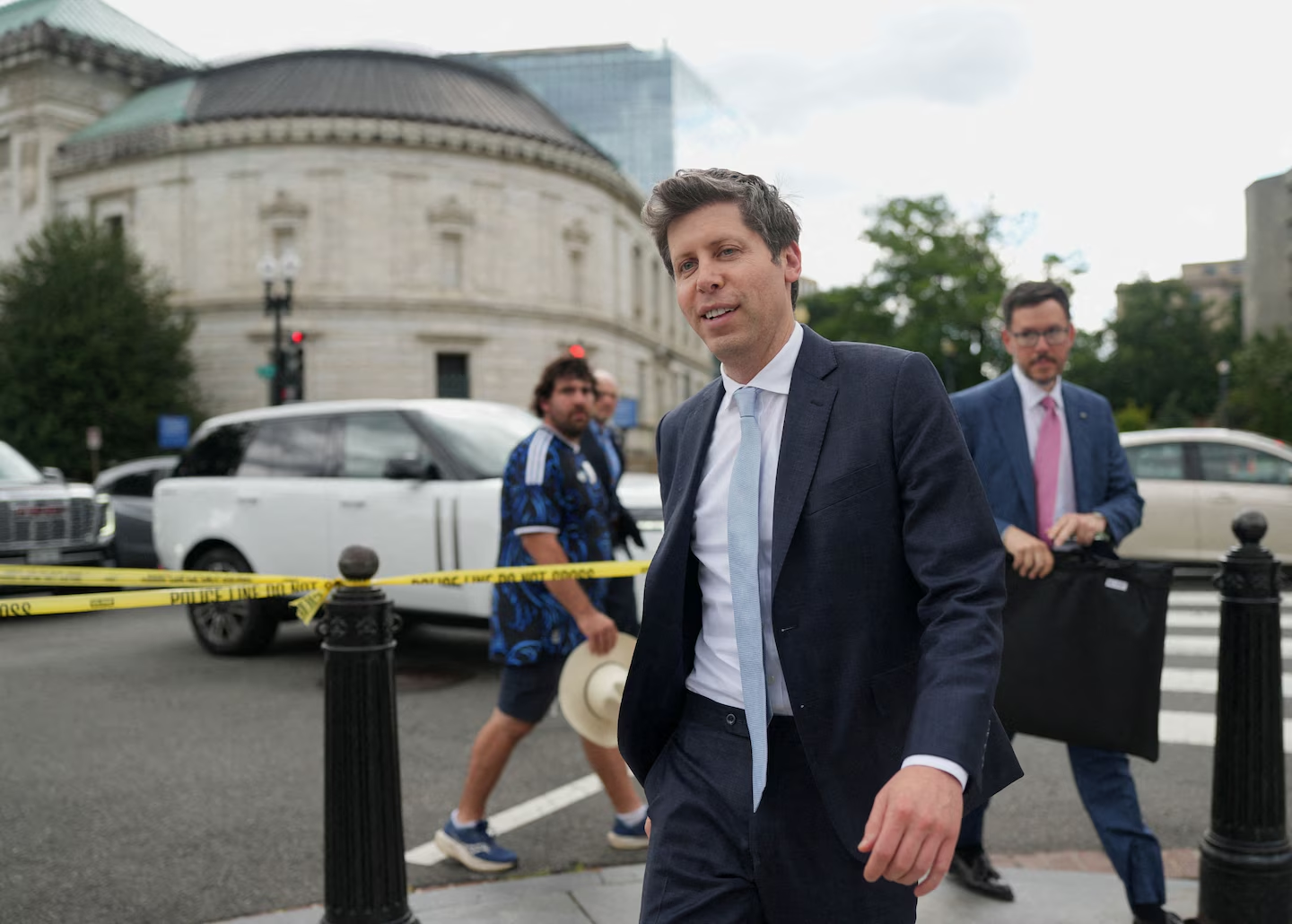
OpenAI has unveiled Astra, its next major model family, claiming the system has resolved or made significant progress on 10 open problems spanning high-dimensional geometry, coding theory, group theory, operator algebras, quantum complexity, lattice cryptography and extremal combinatorics. CEO Sam Altman demonstrated the model to US politicians in Washington D.C. last week, sparking both academic excitement and renewed debate over AI's growing role in mathematical research.
Model Shown to US Politicians
Sam Altman visited Washington D.C. last week to demonstrate Astra directly to US politicians, according to reporting from The Telegraph. The private showing signals how seriously OpenAI is treating the model's potential impact on both scientific research and public policy.
Noam Brown, Research Scientist at OpenAI, confirmed that an internal version of Astra solved 10 major open problems across mathematics, quantum complexity and theoretical computer science, adding that the team is eager to see what scientists build with the upcoming public models.
According to OpenAI, the total token cost to reach these solutions came to roughly US$2,000 at its Sol API rates — a strikingly low figure for problems that have challenged researchers for years. Alongside Astra, the company also announced ChatGPT for Academic Researchers, an initiative giving 100,000 scientists and mathematicians free access to its best models.
Problems Addressed by the System
Astra's internal version tackled work spanning high-dimensional sphere packing, binary and spherical codes, non-sofic groups, Connes's rigidity conjecture, arithmetic circuit complexity, quantum parallel repetition, the closest vector problem, Ehrhart's volume conjecture, multicolour Ramsey numbers and extremal number conjectures.
On Connes's rigidity conjecture, the model produced a disproof of the claim that certain groups are uniquely determined by their von Neumann algebras. On sphere packing — the challenge of arranging spheres to maximise space efficiency — it established tighter upper bounds on packing density, matching the theoretical limit set by the Cohn–Elkies threshold.
"I'm in awe, and excited to see what other things we will learn from the AIs. There are a number of problems I've spent a long time thinking about, and maybe I will learn how to answer them soon."— HENRY YUEN, Associate Professor, Columbia University