
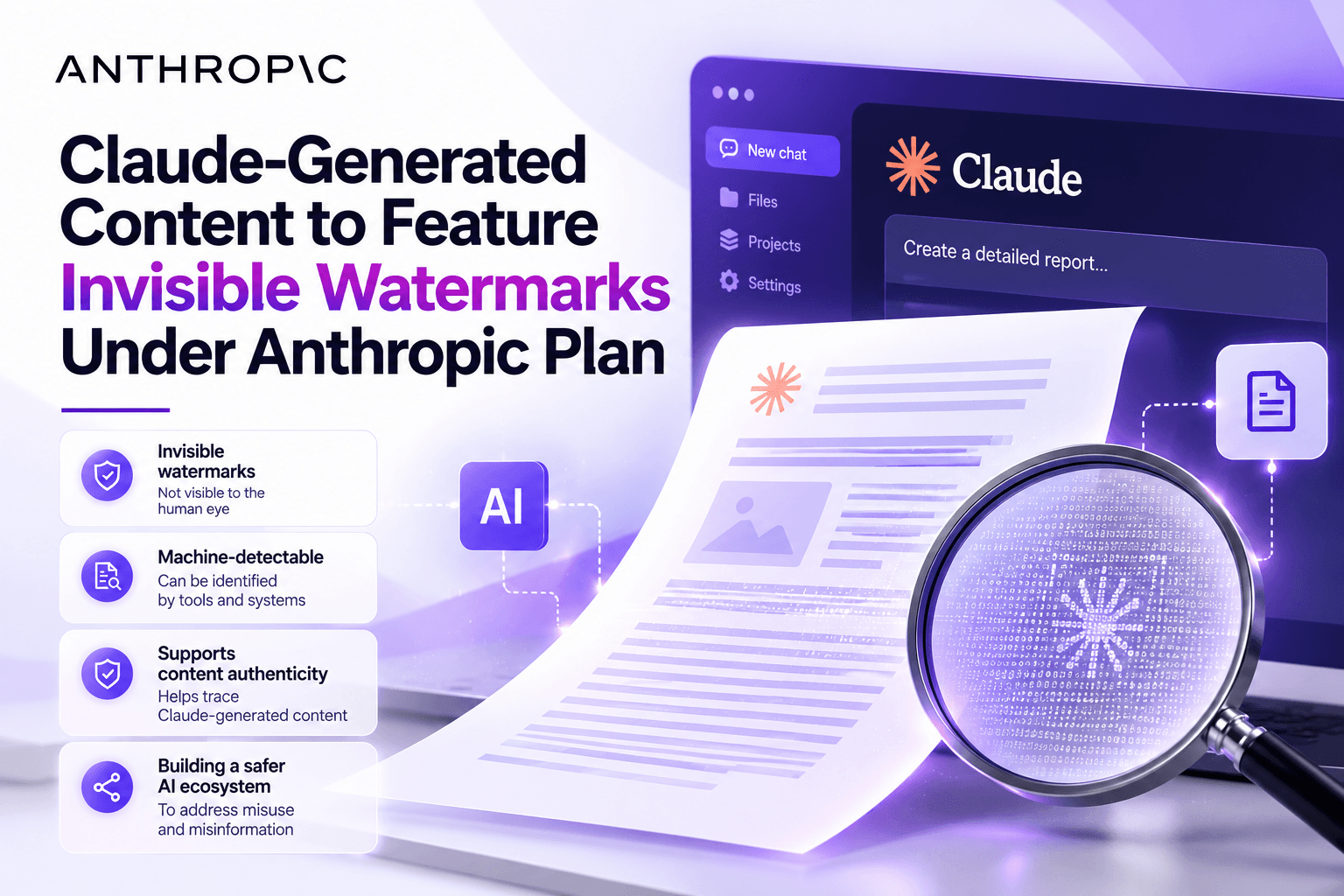
Machine-readable markers will appear in text and files from newer Claude models
Anthropic is adding invisible, machine-readable watermarks to content generated by its newer Claude models. Because the watermark is built into the model itself, it works across Claude's products and integrations, including the Claude API, Claude.ai, Claude Code, and enterprise deployments.
How it works
Unlike a visible watermark such as a semi-transparent logo on a stock photo, this one cannot be seen by the naked eye. For text, it works by statistically nudging Claude's word choices according to a secret key held by Anthropic. Because the signal sits in the wording itself, it travels with the text when it is copied and pasted elsewhere, and may survive some editing.
For files such as .svg, .png and .jpg, Anthropic attaches digitally signed provenance metadata following the C2PA standard.
What users should expect
Anthropic says the method has no practical impact on the quality or content of Claude's outputs, needs no extra tokens, and will not cost more. It carries no identifying information about users, organizations, or specific chats.
Why now
Anthropic says the move is to comply with the EU AI Act. It signed the EU Code of Practice on Transparency of AI-Generated Content, alongside around 190 other signatories. The company is applying the requirement globally rather than only to EU users.
Limits of the technology
Code. Watermarking relies on moments where two word choices are equally good, so code generally carries less watermarking than other kinds of text.
Edited text. When Claude only lightly proofreads a person's writing, there is very little for the watermark to attach to.
No proof of authorship. A detected watermark does not confirm that Claude wrote the content, since the model is widely used to edit, translate and summarize human-written text. It signals that Claude touched the content, not that Claude made it.
Detection. Anthropic plans detection through its own tooling but has given no timeline.