
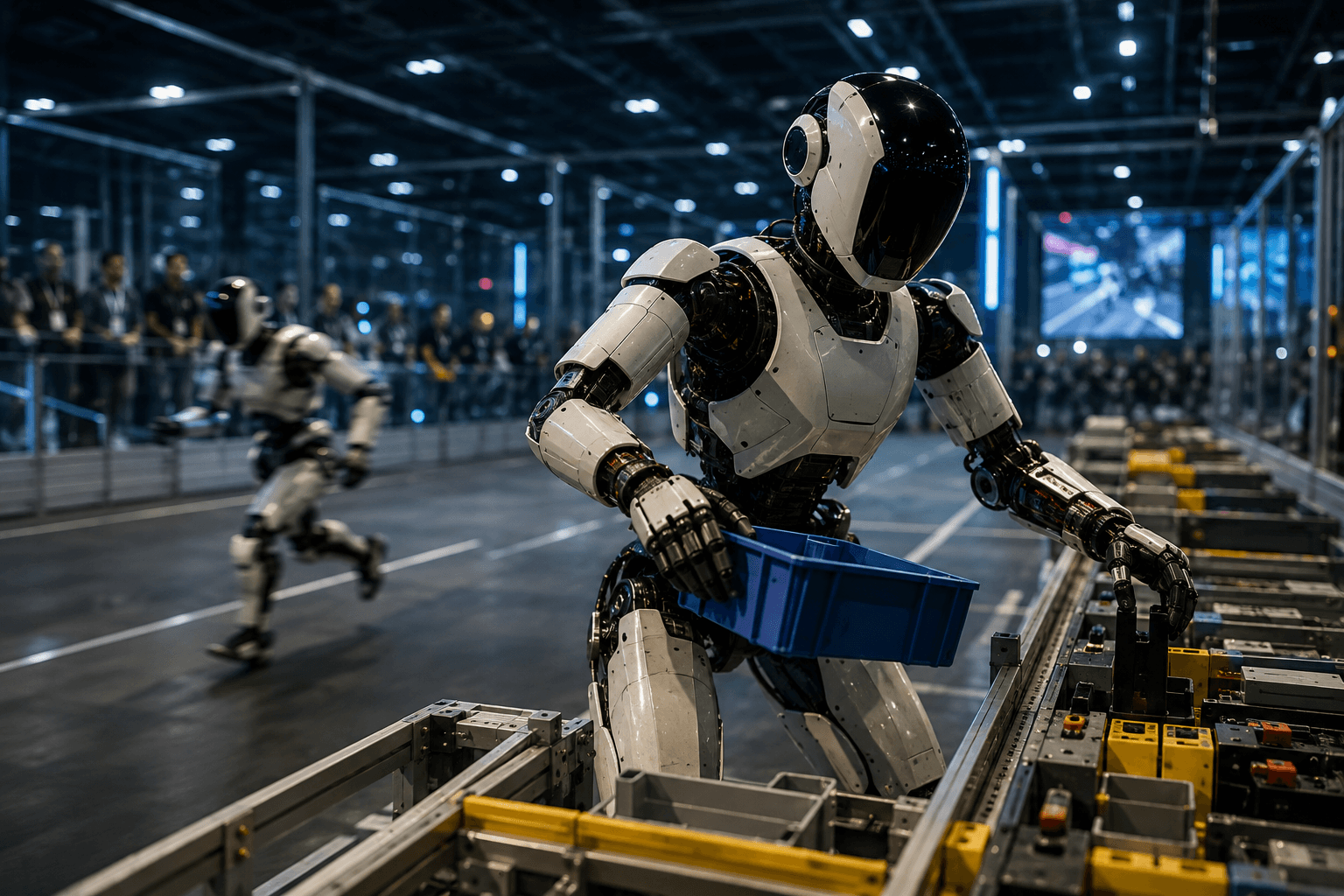
At the World Humanoid Robot Games in Beijing, two robots — Tiangong Ultra and Lightning — have out-sprinted Usain Bolt's 100-metre world record. Yet as the machines slam into padded mats past the finish line, the games are raising a sharper question than raw speed: can these humanoids actually hold their own on a factory floor?
A Year of Dramatic Gains
The leap from last year's inaugural games is striking. In 2025, the winning 100-metre sprint took just over 20 seconds; this year's top humanoid shaved off more than half of that, finishing roughly 2% faster than Usain Bolt's own world record.
Standing high jump results tell a similar story, surging from a top mark of 0.95 metres last year to 2.88 metres this year — a more than 200% increase reflecting rapid progress in hardware, battery output and thermal management across the industry.
Raphael Ross, Director of Solution Consulting, Manufacturing and Supply Chain at Aspen Technology, wrote on LinkedIn that the near future will soon be difficult to even visualise, predicting that robots and AI will become a central political topic as they reshape the economy.
Beyond the Track: Testing Real-World Skill
Held at Beijing's National Speed Skating Oval, the five-day event blends human-style sports with factory, restaurant, office and emergency-response simulations, running alongside the 2026 World Robot Conference, where companies showcased roughly 3,000 products.
More than 2,000 humanoid robots from 16 countries — including Germany, Japan and the US — are competing across roughly 1,000 matches and 51 events, up from just 26 events in 2025. Technology partner Huawei reports that more than 40% of contests demand fully autonomous operation.
Alongside running, table tennis and football, robots are tackling standing high jump, weightlifting and tug-of-war, plus scenario-based contests measuring whether machines can identify objects, position themselves accurately, apply controlled force and recover from errors without human help — including EV charging, restaurant service, material loading and cable-connection tasks that require precise vision and mechanical control.
"Simply running and jumping does not improve efficiency."— Yu Chao, CEO, Lumos Robotics
International Scrutiny for China
China manufactures the majority of the world's humanoid robots, and policymakers there continue to back hardware advances aimed at accelerating deployment across logistics, manufacturing and consumer sectors. Hundreds of robots marching in synchronised formation during the opening ceremony underscored the country's industrial progress.
Even so, China's robotics sector is now facing international regulatory pressure over hardware origins. In July, the US Federal Communications Commission announced an import ban on new foreign-made humanoid robots, citing national security concerns. The US Department of Defence subsequently added Unitree, a leading Chinese humanoid robot manufacturer, to its list of companies with alleged military ties — further restricting trade access for Chinese robotics firms.