
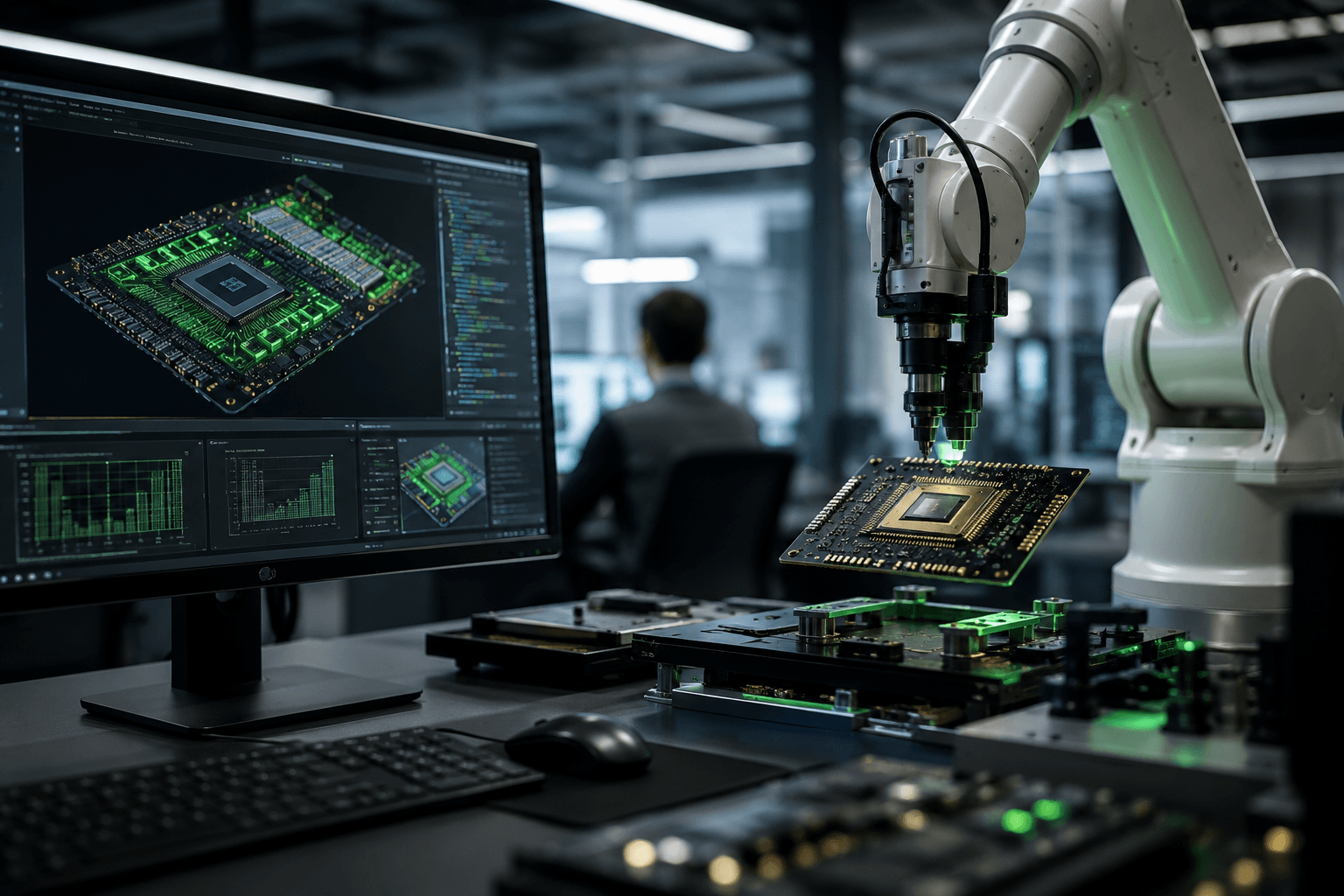
Autonomous AI engineers built by NVIDIA are now taking on one of the most complex tasks in technology: designing the next generation of chips and systems. Through the new NVIDIA Agent Toolkit, an open foundation of models, tools and skills, engineers can build agents that reason with physics, run simulations and generate high-fidelity data — reshaping how semiconductors and systems are built.
Teaching AI the Rules of Real-World Physics
NVIDIA's latest toolset brings several technical breakthroughs directly to engineers and software developers. First, the company is bridging AI with fundamental physics through its PhysicsNeMo libraries. Instead of relying on traditional, slow-moving physics calculations, this technology allows developers to teach AI models how physical forces work — such as airflow around an aircraft wing or heat moving through an engine block.
Engineers can then plug these customisable AI models straight into their everyday design tools, getting fast, reliable feedback without having to wait hours for a simulation to render.
When it comes to raw calculations, physical models rely heavily on sparse linear systems — gigantic mathematical grids where most entries are zero, but the non-zero parts are extremely hard to solve. To tackle this, NVIDIA introduced cuISS, a library of iterative sparse solvers that makes an educated guess at a complex calculation and refines it rapidly until it reaches an exact solution, built to run across multiple GPUs for scalable simulation engines.
For problems requiring numerical accuracy rather than smart guesses, NVIDIA offers cuDSS, a library of direct sparse solvers that works through every step of an equation to find an exact answer without trial and error — critical in Electronic Design Automation, where unforgiving circuit layouts leave zero margin for error.
Finally, NVIDIA is bringing atomic-level science into the fold with cuEST, a tool dedicated to quantum chemistry. By accelerating Electronic Structure Theory formulas on GPUs, cuEST allows researchers to model much larger, real-world molecular structures — including next-generation semiconductors, battery materials and pharmaceuticals — while retaining sub-atomic accuracy.
"Engineering has reached an inflection point. AI can now work with tools of physics, simulation and design. With NVIDIA Agent Toolkit, developers can build agentic engineers that reason using physics, run complex simulations and generate high-fidelity data to become a new engine for innovation in chip and system design."— Timothy Costa, Vice President and General Manager of Computational Engineering, NVIDIA
Automating Chip Design
NVIDIA created Nemotron 3 Ultra, an AI model tuned specifically to help write and test chip blueprints. Working alongside an AI system called ACE-RTLE, developed by NVIDIA Research, this AI can understand chip design problems and write the necessary hardware code better than other open-source AI models available today.
Nemotron 3 Ultra is designed so technology companies can run the model on their own private, on-premises servers and train it further using their own confidential data — giving companies privacy, customisation, control and efficiency.
Engineers won't have to change how they work to use it. NVIDIA integrated Nemotron 3 Ultra straight into major software suites that chip designers rely on every day, including tools from Cadence, Siemens and Synopsys, or developers can access it via open platforms like Hugging Face.
Complementing this AI software, NVIDIA is also deploying its custom Vera CPU to power the underlying hardware computing for these workflows. In early testing with partners like Cadence and Synopsys, the Vera CPU delivered up to 1.5x higher performance on critical chip verification and simulation tasks — creating a continuous feedback loop that uses NVIDIA's own CPUs and AI tools to accelerate the design of its next-generation processors.
"Simulation, verification and implementation technologies play a central role in semiconductor development. Long before a chip reaches manufacturing, engineers spend years validating behaviour, identifying corner cases and refining designs through thousands of iterations."— Ivan Goldwasser, Senior Product Marketing Manager, NVIDIA Data Center Group