
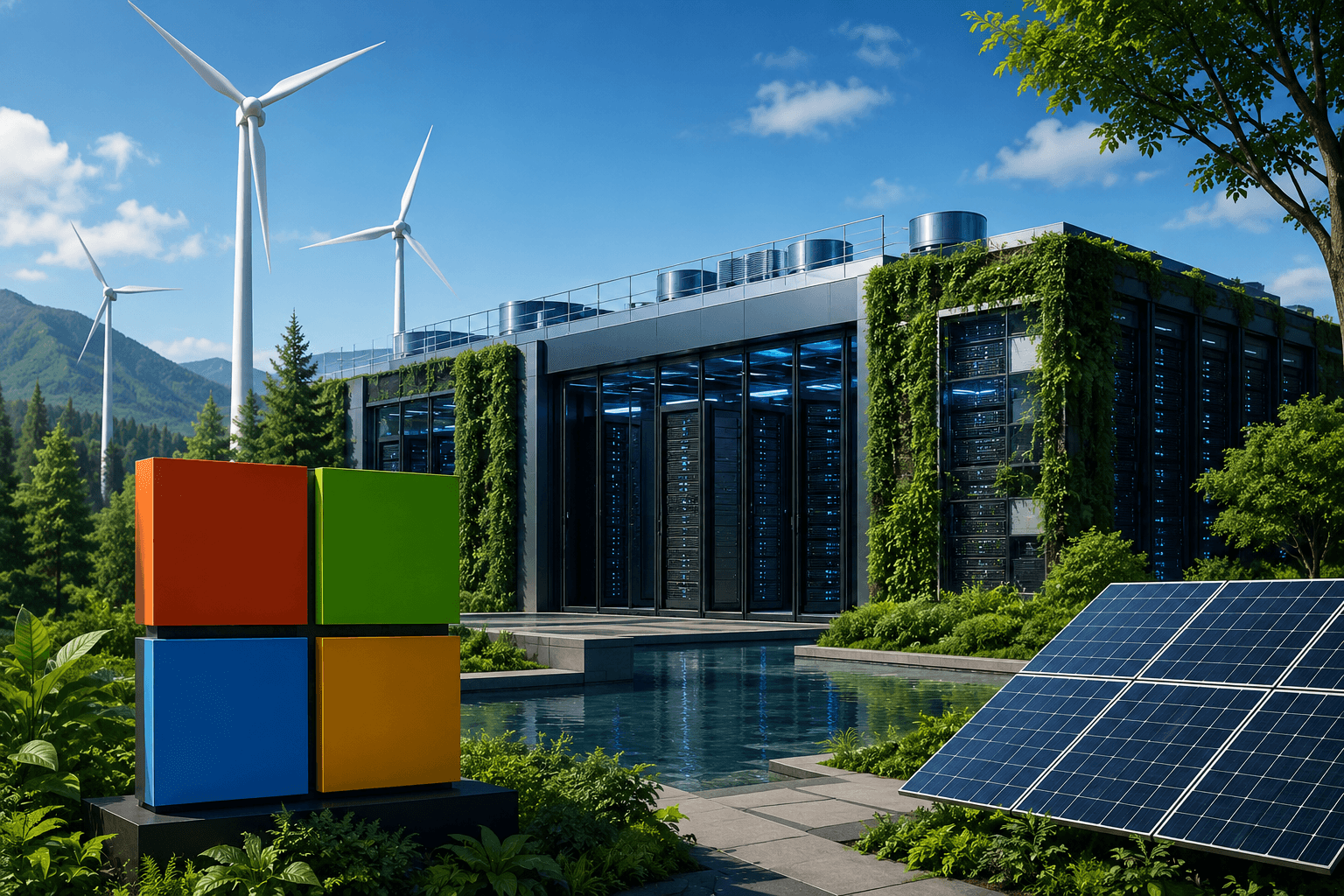
Microsoft is weaving sustainability into the core of its hardware stack, data centre architecture and supply chain, according to the company's 2026 Environmental Sustainability Report. The report lays out a technical roadmap for scaling AI infrastructure while easing the strain on power, water, land and raw materials that comes with it.
Re-engineering the Data Centre
Every AI workload is limited by the physical realities of the data centre. To squeeze more performance out of every watt, Microsoft has moved away from legacy building designs toward highly specialised, low-impact structures built around a full-lifecycle engineering approach.
Among the key innovations: multi-storey data centres that stack server halls vertically, engineered timber used in place of high-carbon concrete and steel to cut embodied carbon, and liquid cooling with closed-loop systems that keep dense AI clusters running while limiting freshwater use.
Microsoft is also aligning new data centre builds with local power grids, aiming to support rather than strain the energy and water systems of the communities where it operates.
"Sustainability outcomes will increasingly depend on our ability to align innovation with stewardship."— Melanie Nakagawa, Chief Sustainability Officer, Microsoft
Power and Water
Training and running large language models demands enormous electrical loads. Microsoft has tackled this at both ends of the supply chain — from macro-level energy sourcing down to micro-level server operations.
In its 2025 fiscal year, the company matched 100% of its global electricity consumption with renewable energy, backed by heavy investment in carbon-free grids, transition fuels such as renewable diesel, and next-generation clean energy technology.
Inside its server halls, Microsoft relies on software-defined infrastructure — including power harvesting, which temporarily reallocates power to active workloads while throttling idle hardware — to push its global average power usage effectiveness down to 1.17. On water, the company reached a milestone in FY25 by replenishing more water globally than it withdrew, edging closer to its water-positive goal.
Using AI to Optimise AI
Beyond hardware and buildings, Microsoft is also turning to AI itself to solve the resource challenges that come with running AI. Machine learning models deployed across its infrastructure help fine-tune real-time cooling adjustments, improve chip-level energy efficiency and sharpen environmental predictive modelling.
Through programmes like the AI for Good Lab, Microsoft is extending these tools beyond its own operations, helping partners and suppliers decarbonise as well. The company frames its 2026 approach as proof that the next era of high-performance computing must be built on efficiency and circularity rather than brute-force power.
On the packaging side, Microsoft reported reaching 99.93% plastic-free primary product packaging by the end of 2025, and diverted 90.5% of construction and demolition waste from landfills and incinerators across its infrastructure projects.