
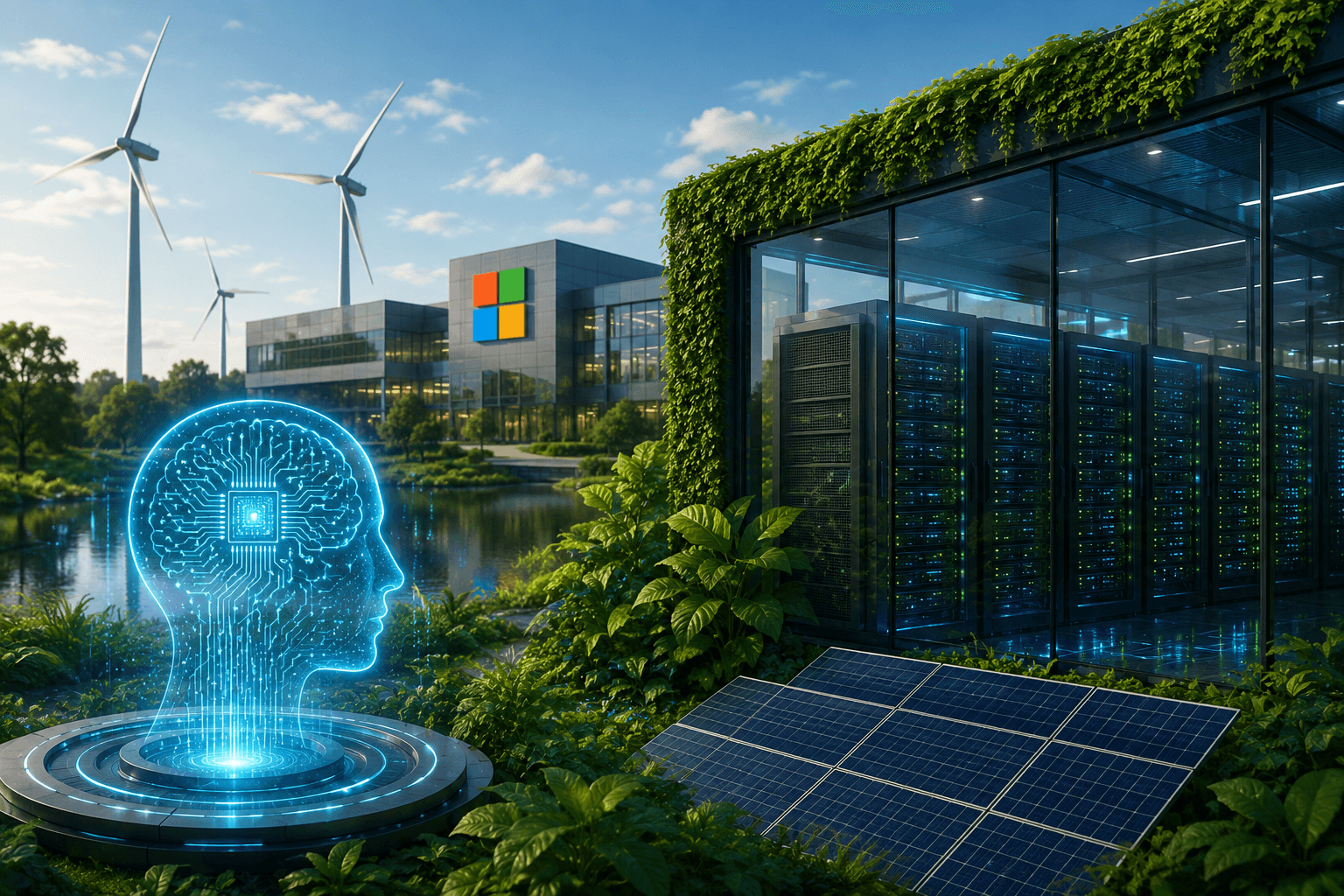
Microsoft has released its 2026 Environmental Sustainability Report, offering a detailed technical blueprint for scaling its global AI footprint while decoupling growth from resource depletion. From matching global electricity use with renewable energy to deploying robotics-driven hardware recycling and mass timber construction, the report lays out the systems engineering challenge of meeting surging demand for power, water, land and raw materials.
Re-engineering the Data Centre
Every AI workload is bound by the physical constraints of the data centre. To optimise performance per watt, Microsoft is implementing a full-lifecycle engineering approach to its facilities, moving away from legacy building designs toward highly specialised, low-impact structures.
Key innovations include multi-storey data centres that stack server halls vertically, engineered timber replacing high-carbon concrete and steel to reduce embodied carbon, and liquid cooling and closed-loop systems that keep high-density AI clusters running while cutting freshwater consumption. Microsoft is also aligning its data centre deployments with local grids so new builds support, rather than strain, local energy systems and water resources.
"Sustainability outcomes will increasingly depend on our ability to align innovation with stewardship. That means being accountable for the impacts of growth, strengthening partnerships and staying focused on durable outcomes for communities and the environment."— Melanie Nakagawa, Chief Sustainability Officer, Microsoft
Power and Water
The compute-heavy nature of training and running large language models requires massive electrical loads. Microsoft has met this challenge by optimising both the macro supply chain and micro-level server operations. In FY25, the company matched 100% of its annual global electricity consumption with renewable energy, investing heavily in carbon-free grids, transition fuels like renewable diesel, and next-generation clean energy technology.
Inside the server halls, efficiency is driven by software-defined infrastructure. Microsoft uses power harvesting — temporarily over-allocating power to active workloads while throttling underutilised hardware — alongside optimised workload distribution across virtualised environments, driving its global average PUE down to 1.17.
On water, Microsoft reached a major milestone in FY25, replenishing more water globally than it withdrew for the first time — more than 14 million cubic metres — marking progress toward becoming water positive.
Using AI to Optimise AI
Microsoft is using AI itself to solve the resource challenges of running AI. By running advanced machine learning algorithms across its infrastructure, the company optimises real-time cooling adjustments, improves chip-level energy efficiency, and refines environmental predictive models.
Through initiatives like the AI for Good Lab, Microsoft is scaling these technical solutions outward, helping partners and suppliers decarbonise their own operations. Ultimately, the 2026 strategy signals that the next era of high-performance computing cannot rely on brute-force power — the future belongs to systems designed for maximum efficiency, circularity and environmental stewardship from the silicon up.