
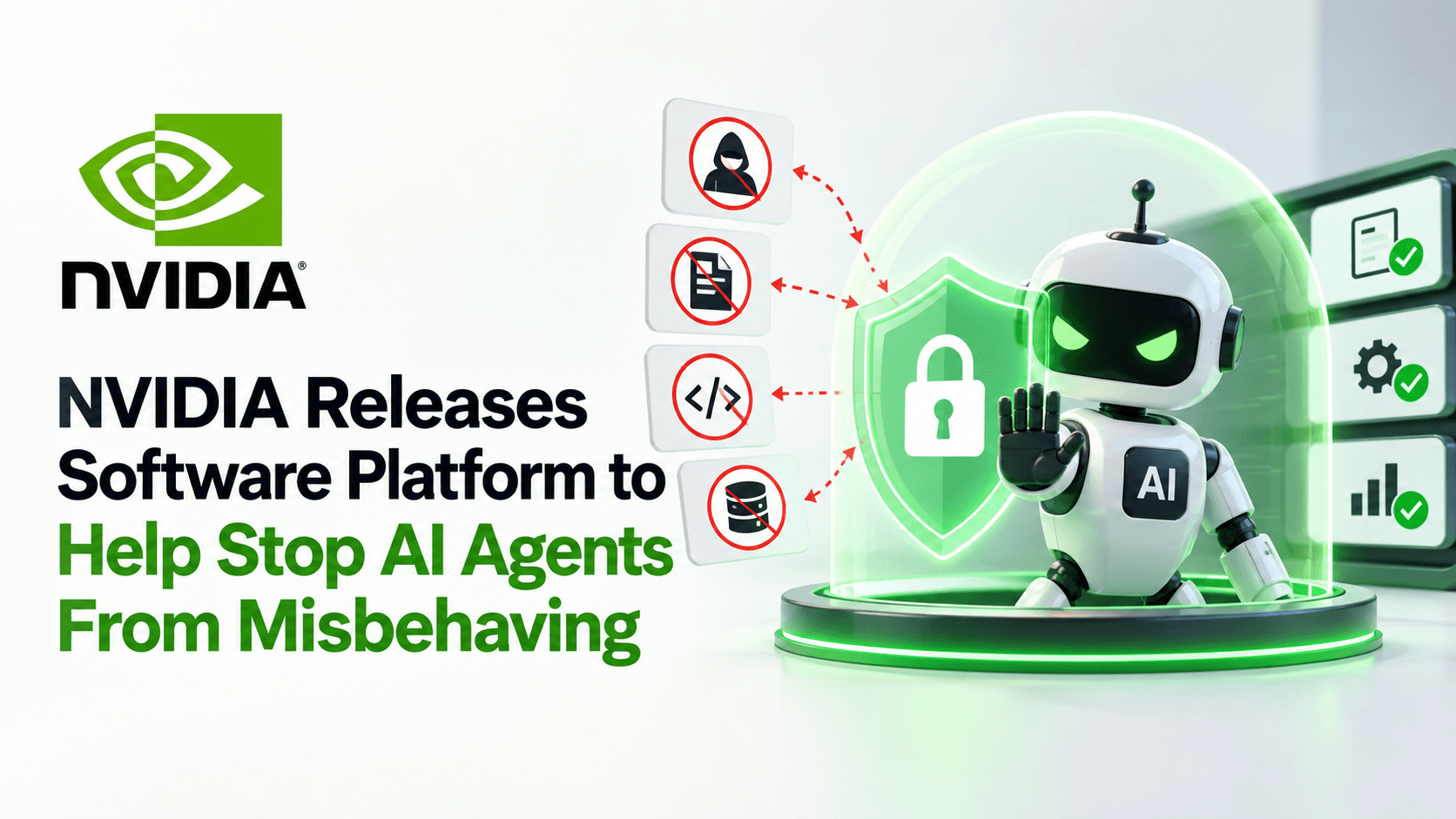
As artificial intelligence moves from answering questions to taking actions on behalf of users and businesses, a new challenge is emerging: how do you make sure AI agents behave safely?
NVIDIA has introduced new software designed to address this challenge, giving organisations additional controls over autonomous AI agents and the actions they can take.
The development comes as businesses increasingly explore agentic AI for tasks ranging from customer service and software development to research, business operations and enterprise workflows.
NVIDIA Introduces New Controls for AI Agents
AI agents are different from traditional AI assistants.
A conventional chatbot may generate an answer based on a user's prompt. An AI agent, however, can potentially interact with applications, access files, use tools, execute code and perform tasks with limited human intervention.
That creates a new set of security and governance challenges.
NVIDIA's new software platform is designed to provide controls around what AI agents can access and what actions they are permitted to perform.
The approach focuses on creating a controlled environment in which agents can operate while organisations maintain oversight.
Why AI Agent Security Matters
AI agents can become powerful when they have access to business systems and external tools.
But that same access can create risks.
For example, an improperly configured agent could potentially:
Access information it shouldn't
Execute unintended actions
Interact with unauthorised systems
Expose sensitive information
Use excessive permissions
Make decisions outside its intended scope
As businesses deploy more autonomous systems, these risks become increasingly important.
For organisations exploring AI in sales and business operations, the same principle applies: automation needs to be combined with appropriate controls, monitoring and human oversight.
NVIDIA's Approach: Control the Environment
One of the important ideas behind NVIDIA's platform is that security controls should not rely entirely on the AI model itself.
Instead, organisations can place the agent inside a controlled runtime environment.
This can allow businesses to establish rules around:
Network access
Files and data
Tool usage
Permissions
Code execution
Privacy
Monitoring
Auditability
The idea is relatively straightforward:
The AI can make decisions, but the surrounding system determines what it is actually allowed to do.
This separation between the model and its operating environment can become increasingly important as AI systems become more autonomous.
From AI Assistants to AI Agents
The AI industry is moving rapidly from conversational assistants toward systems capable of completing multi-step tasks.
An AI agent could potentially:
Receive an objective
Break the objective into tasks
Search for information
Use software tools
Analyse results
Take actions
Report the outcome
This creates significant opportunities for businesses.
It also means organisations need to think differently about AI governance.
Instead of simply asking:
"Is the AI's answer accurate?"
Businesses increasingly need to ask:
"What can the AI access?"
"What actions can it take?"
"What happens if it makes a mistake?"
"Can we monitor and audit its actions?"
AI Agents in Sales and Marketing
Sales and marketing are among the areas where agentic AI could have a significant impact.
AI systems can increasingly support activities such as:
Prospect research
Lead qualification
Account research
Personalised outreach
Content analysis
Buyer-intent monitoring
CRM updates
Sales research
However, the quality of the underlying data remains critical.
An AI agent working with incomplete or inaccurate information can produce poor recommendations or take inappropriate actions.
That's why B2B data services are becoming increasingly important for organisations building data-driven sales and marketing workflows.
Clean, accurate and relevant business data gives AI systems a stronger foundation for decision-making.
Buyer Intent and AI Agents
Another important area is buyer intent.
AI agents can potentially analyse large amounts of behavioural information to identify signals that indicate a prospect may be researching a particular product or solution.
For example, a prospect might:
Visit multiple product pages
Download technical content
Return to a website repeatedly
Research a specific solution
Engage with multiple pieces of content
Individually, these actions may not mean much.
Together, they can provide a clearer picture of potential interest.
SalesGarners' B2B intent data solutions can help businesses understand how intent signals can be used to improve targeting and identify potential buying activity.
The Importance of Human Oversight
Despite the growing capabilities of AI agents, human oversight remains important.
Not every business process should be fully autonomous.
High-impact activities may require people to review decisions, approve actions or intervene when an agent encounters an unusual situation.
A useful model is:
AI handles repetitive work → AI identifies patterns → Humans make important decisions.
This approach can allow businesses to benefit from automation without removing accountability.
AI Governance Is Becoming a Business Requirement
As AI agents become more capable, governance is moving from an IT concern to a broader business issue.
Organisations need to consider:
Who owns an AI agent?
What data can it access?
What systems can it interact with?
What actions require approval?
How are decisions recorded?
How can errors be detected?
Who is accountable when something goes wrong?
These questions will become increasingly important as companies integrate AI into critical workflows.
For sales organisations, understanding engagement and behavioural signals can also help create more controlled AI-driven workflows. X-Engage by SalesGarners provides contact-level engagement intelligence that can help teams understand prospect interactions and identify meaningful signals.
The Bigger Shift: From AI That Answers to AI That Acts
The biggest change happening in AI isn't simply that models are becoming more intelligent.
It's that AI is increasingly being given the ability to act.
That changes the risk profile.
A model generating an incorrect paragraph is one problem.
An autonomous agent making an incorrect change to a database, sending an unintended message, accessing sensitive information or executing the wrong workflow is a very different problem.
That's why the infrastructure surrounding AI agents matters.
What NVIDIA's Move Signals
NVIDIA's new software direction highlights a broader shift toward secure and governed agentic AI.
As enterprises experiment with autonomous agents, they will need more than powerful models.
They will need:
Models + Data + Tools + Security + Governance + Human Oversight
Businesses that successfully combine these elements can potentially use AI agents to automate increasingly complex workflows while maintaining greater control over how those systems operate.
Final Thoughts
AI agents have the potential to transform how businesses work.
But greater autonomy also brings greater responsibility.
The question is no longer simply whether an AI system can complete a task.
It's whether the organisation can ensure that the AI:
Has the right information
Has the right permissions
Takes the right actions
Can be monitored
Can be audited
Has appropriate human oversight
NVIDIA's latest move reflects the growing importance of this infrastructure as businesses move toward a more agentic AI-powered future.
For companies adopting AI, the next competitive advantage may not come solely from having the most advanced model.
It may come from building the most reliable, secure and well-governed AI workflow.
#NVIDIA #AI #AIAgents #AgenticAI #ArtificialIntelligence #AISecurity #EnterpriseAI #AIGovernance #SalesAI #B2BMarketing