
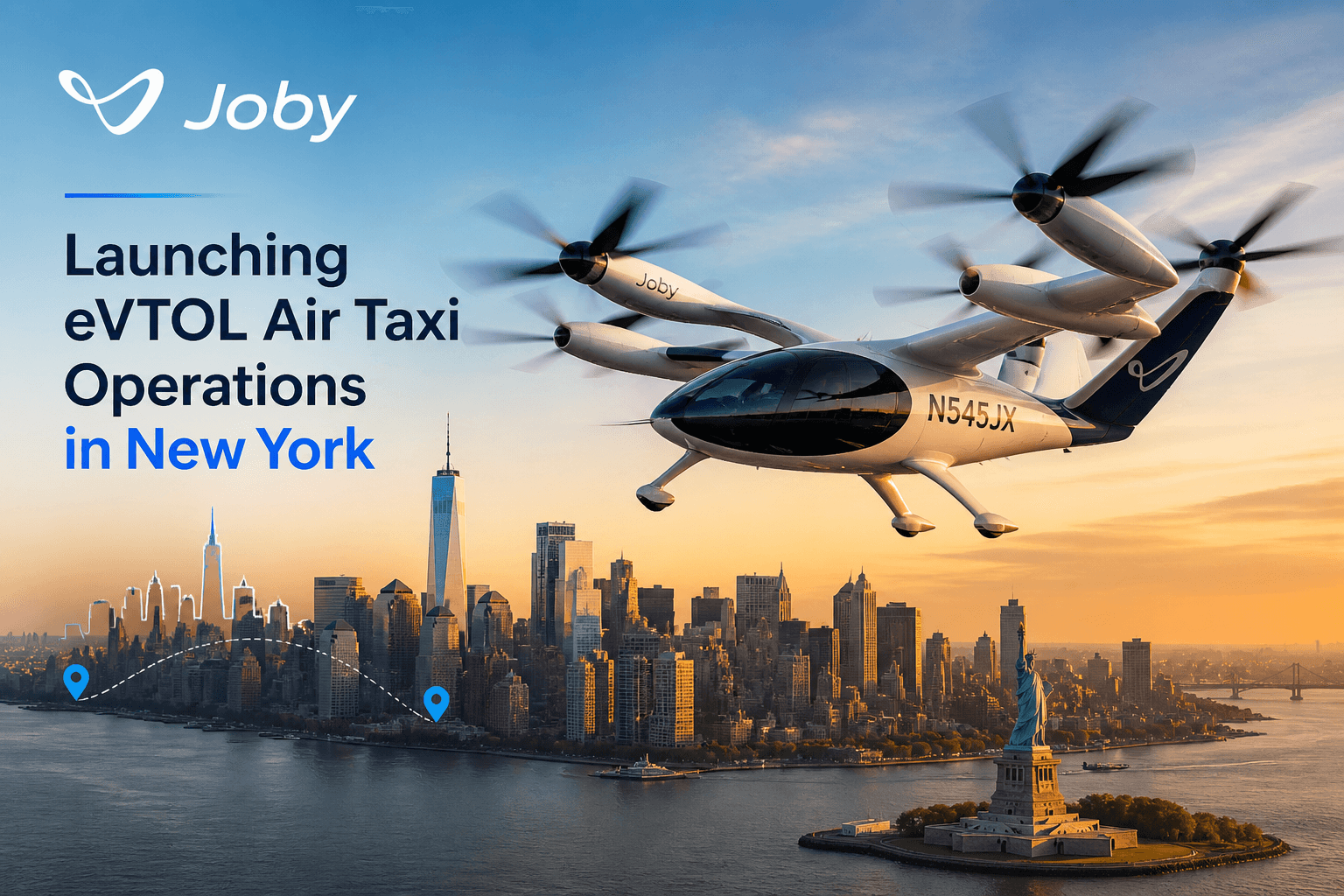
A new chapter in urban transportation has begun. Joby Aviation (NYSE: JOBY) has completed New York City's first-ever point-to-point eVTOL air taxi demonstration flights — taking off from John F. Kennedy International Airport and touching down at Manhattan heliports in under 15 minutes. What once sounded like science fiction — a quiet, zero-emissions electric aircraft skipping over gridlocked city streets — is now a proven, FAA-airspace-integrated reality. And New York is just the beginning.
Historic Flights Over New York City
Joby Aviation's production prototype aircraft — designated N545JX — took off from JFK Airport on April 27, 2026, and landed at Manhattan's Blade Air Mobility lounge in Midtown in just 15 minutes. The same journey by road routinely takes between 60 and 120 minutes. The demonstration marked the first time an eVTOL aircraft had ever completed a point-to-point commercial-route flight in New York City's history, operating seamlessly within FAA-controlled airspace.
The flights were conducted as part of a week-long public campaign across the city's existing heliport network — touching down at Downtown Skyport, West 30th Street, and East 34th Street in Midtown Manhattan. They took place under the FAA's eVTOL Integration Pilot Program (eIPP), a White House-backed initiative designed to accelerate the integration of electric aircraft into real-world urban environments. The Port Authority of New York and New Jersey served as the lead partner for the project, working closely with the FAA, Joby, and other eIPP partners to make the flights possible.
The reaction on the ground was immediate. Blade customers waiting for helicopter flights to JFK saw the Joby aircraft land and asked if they could wait and take it instead — an organic, unscripted signal of the pent-up public demand for this technology.
"These historic Joby flights, linking our city-owned heliport to our airports, are proof that the future of advanced air mobility is no longer a Jetsons-esque fantasy — it's already here."— Jeanny Pak, Interim President & CEO, NYC Economic Development Corporation
The Aircraft: Built for Speed, Silence, and Sustainability
The Joby S4 is purpose-built for urban air mobility. Powered by six electric motors, six propellers, four battery packs, and a triple-redundant flight computer, the aircraft can carry one pilot and four passengers at speeds of up to 200 mph at 10,000 feet — all with zero operating emissions. The airframe is constructed from a titanium-aluminium-carbon fibre composite, with components manufactured using robotic 3D printing for precision and consistency at scale.
But perhaps the aircraft's most commercially important feature is its acoustics. Unlike conventional helicopters — which generate significant noise — the Joby S4 is engineered to be dramatically quieter. During the New York demonstration, the door of the aircraft was left open on landing at the Blade lounge in Midtown. If a helicopter had done the same, the noise inside the lounge would have been overwhelming. Joby's Chief Product Officer Eric Allison highlighted this as central to the company's market strategy: the quietness of the aircraft means it can land closer to where people live and work — a critical advantage that traditional helicopters simply cannot match.
The Blade Acquisition: Infrastructure Already in Place
Central to Joby's New York strategy is its 2025 acquisition of Blade Air Mobility's passenger business — now a wholly owned subsidiary of Joby. Blade's network of premium passenger lounges at JFK, Newark, West 30th Street, East 34th Street, and the Downtown Skyport served more than 90,000 passengers in 2025, giving Joby immediate access to an established customer base and the physical infrastructure it needs to launch commercial service at scale.
This means Joby does not need to build its New York footprint from scratch. The lounges, routes, and passenger relationships already exist. The pivot from helicopter to eVTOL service can happen efficiently — transitioning Blade's existing customers directly onto the new, quieter, zero-emissions platform. The NYC Economic Development Corporation, alongside infrastructure partners Skyports and Vertiports by Atlantic, is also electrifying city-owned heliports to support eVTOL charging ahead of commercial launch.
FAA Certification: The Final Stretch
Joby has now completed Stage 4 of the FAA's five-stage certification process — the furthest any eVTOL manufacturer has progressed — and has begun flight testing its first conforming aircraft under the FAA's Type Inspection Authorization (TIA) process. This means FAA pilots will soon take the controls and conduct for-credit test flights, the final major hurdle before full commercial certification is granted.
The company is targeting the second half of 2026 for its first commercial passenger flights in the United States. While full FAA certification remains a multi-quarter effort, the New York flights demonstrated that Joby's aircraft can operate in some of the world's most complex and congested airspace — a powerful proof point that the certification process is on track.
Joby is ahead of rival Archer Aviation in the certification race, which remains behind in the FAA's five-stage process. Other competitors including UK-based Vertical Aerospace are pursuing similar urban air mobility routes in Europe, cementing the global nature of the eVTOL race. McKinsey has predicted that passenger advanced air mobility operators could rival today's largest airlines in flights per day and fleet size by 2030.
What This Means for New York — and Cities Worldwide
The numbers tell a striking story. A typical New York commuter lost an estimated 102 hours to traffic congestion in 2025. The standard road journey from Midtown Manhattan to JFK Airport takes 60 to 120 minutes. Joby's air taxi covers the same distance in under 10 minutes. At scale, the implications for urban productivity, quality of life, and transportation sustainability are enormous.
The New York flights also demonstrated something equally important: that eVTOL aircraft can integrate into existing urban infrastructure — existing heliports, existing airspace, existing passenger lounges — without requiring a complete overhaul of the city's transportation network. This dramatically lowers the barrier to commercial launch and accelerates the timeline to everyday, bookable electric air taxi service for ordinary city dwellers. The "Grand Skies" US tour continues, with New York as the second stop following San Francisco — and with 26 states in the eIPP programme, the electrification of urban skies across America is well and truly underway.