
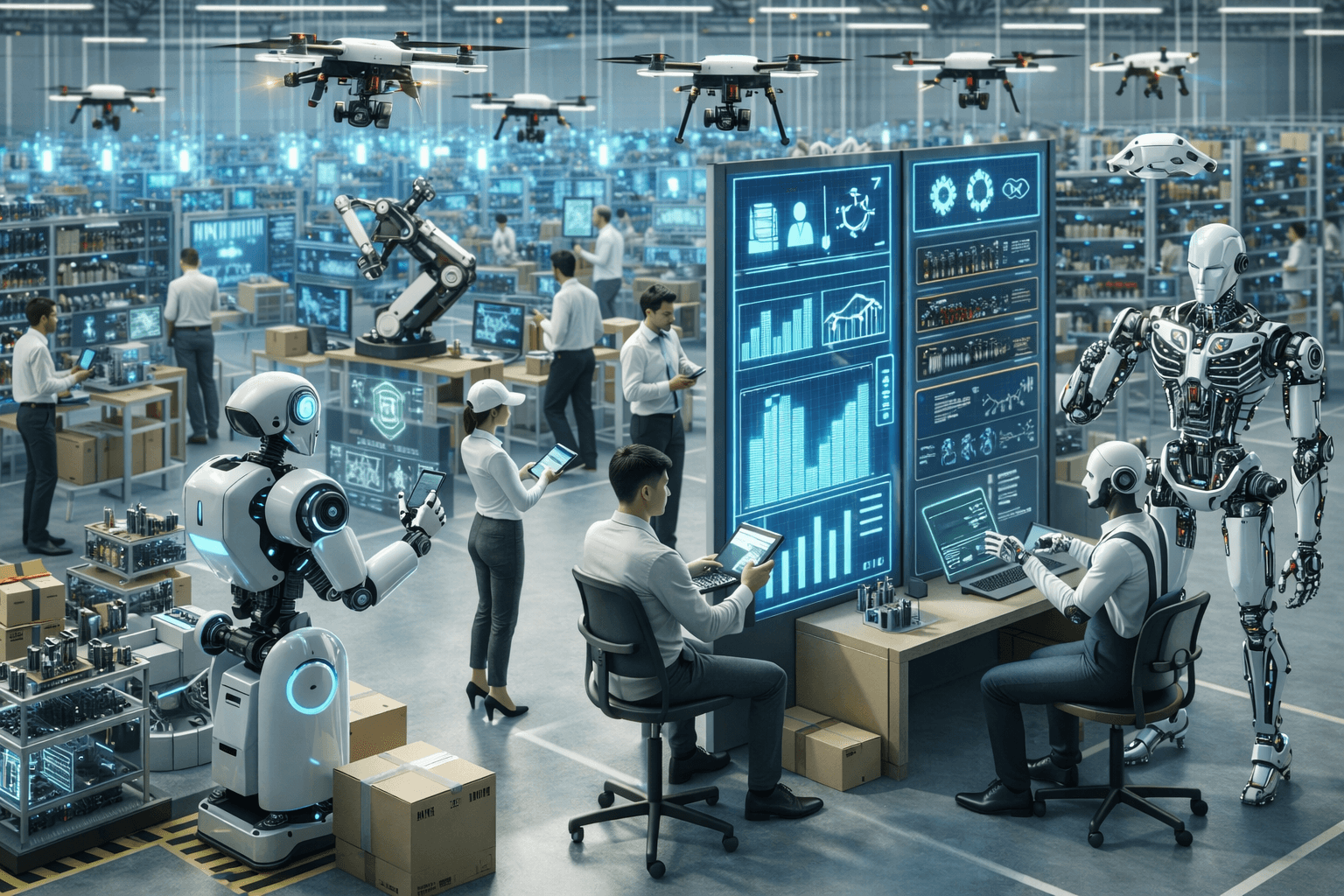
WEF Study Reveals How Tech Giants Are Using AI to Transform Work, Skills, and Inclusivity
Read time: 3 minutes
Released at Davos, a World Economic Forum study shows how the world’s leading tech giants are integrating AI to boost skills, trust, and inclusivity.
Thanks to advances in AI, companies across industries and around the world are re-engineering their day-to-day operations around machine intelligence. The latest paper from the World Economic Forum (WEF), AI at Work: From Productivity Hacks to Organisational Transformation, offers insight into how more than 20 of the world’s most influential technology companies and their clients are redefining the nature of work in the intelligent age.
The report has been released as business and political leaders travel to Switzerland for the World Economic Forum Annual Meeting 2026, commonly known as Davos.
Youtube Placeholder
Leaders from 25 firms including Cisco, ServiceNow, Pegasystems, and Wipro will formalize a joint pledge to expand access to AI tools, enhance global digital skills, and create new routes into “AI-native” jobs. The initiative is expected to impact more than 120 million people by 2030.
How AI Is Transforming Workflows
Three years after the launch of ChatGPT, AI’s impact on the workplace is undeniable. From triaging legal contracts to detecting financial anomalies and streamlining healthcare processes, organizations are using AI to drive unprecedented efficiency.
Youtube Placeholder
One company analyzed months of tax data and regulatory information to uncover US$120 million in savings, reducing a filing process from weeks to just three days. Another reduced a 30-minute lab-ordering procedure to seconds, saving 30,000 hours annually.
These examples show that the greatest gains come not from surface-level automation, but from redesigning workflows around AI from the ground up.
“Across multiple industries, we already see gains as AI enables employees to complete tasks faster and more accurately. The greatest transformation will come as organisations redesign workflows from the ground up around AI and invest in advanced AI skills.”
– Nathan Jokel, SVP of Corporate Strategy and Alliances, Cisco
The Impact on Career Progression
AI is also reshaping career ladders. While much attention has been paid to entry-level roles, WEF highlights that mid-level roles may face greater pressure as automation accelerates.
Junior employees now advance faster by using AI copilots and assistants to participate in client meetings and complex tasks previously reserved for senior staff.
“We will work with AI to support decision-making, handle repetitive tasks, and free humans to focus on meaningful work. Org charts will soon include AI agents as formal team members.”
– Hala Zeine, SVP & Chief Strategy Officer, ServiceNow
Youtube Placeholder
The Cultural Shift
Beyond productivity, executives report softer benefits from AI adoption. AI reduces burnout, minimizes repetition, and enables employees to focus on creative problem-solving rather than administrative tasks.
Some organizations use AI to personalize learning and communication training, potentially making happiness and cultural cohesion as measurable as efficiency.
The WEF Commitment
At Davos 2026, leaders from 25 companies will endorse the “Commitment to Creating Economic Opportunities for All in the Intelligent Age”, guided by three pillars:
- Access: Affordable or free AI tools for workers worldwide
- Skills: Digital and human skills development for AI-augmented roles
- Job Pathways: Apprenticeships, skills-based hiring, and local engagement
“The tech industry shapes economies and societies. As AI becomes embedded in life, we must lead workforce development for a Human+AI future.”
– Ajay Bhaskar, Chief Strategy and Transformation Officer, Wipro
Building Trust and Governance
Trust remains the foundation for scaling AI. In regulated industries, predictability, transparency, and traceability are essential.
Youtube Placeholder
“At design time, AI drives creativity. At run time, especially in regulated sectors, we need predictable and auditable outcomes. AI must be orchestrated, not treated as a black box.”
– Steve Rudolph, VP of Strategy and Transformation, Pegasystems
The Forum concludes that the transformation of work is irreversible. The challenge now is ensuring that AI enhances prosperity, reduces inequality, and strengthens collaboration between humans and intelligent systems.