
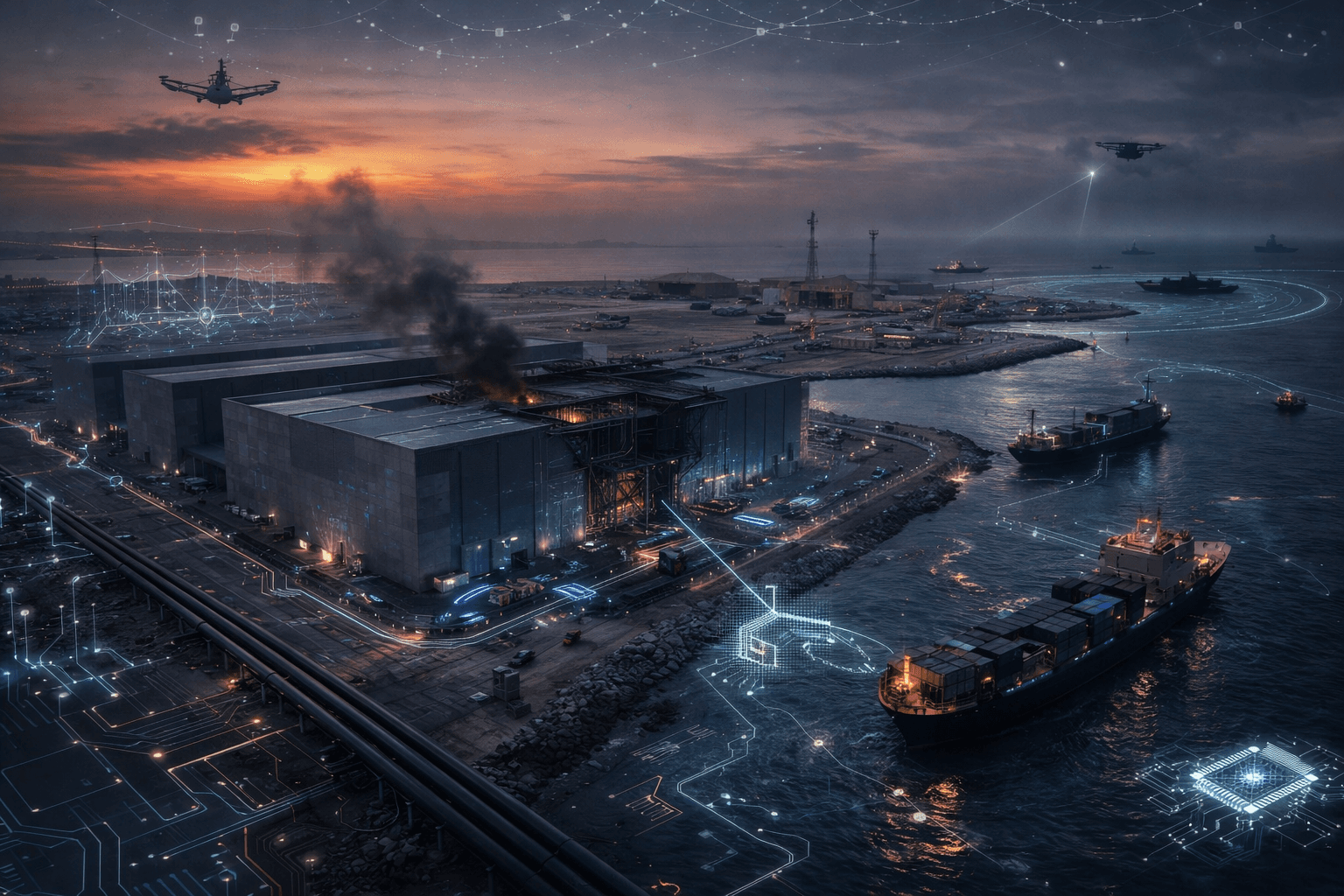
Cloud, Chips, and Cargo: How the US–Iran Conflict Is Hitting Global Tech Flows
| 6 min read
The ongoing US–Iran conflict has rapidly escalated from a geopolitical flashpoint into a full-blown crisis for the global technology economy. From cloud infrastructure and semiconductor supply chains to air cargo routes and petrochemical inputs, the ripple effects are now reaching every corner of the digital world — and the pressure is still building.
The Strait of Hormuz: A 21-Mile Chokepoint Threatening the Tech World
The Strait of Hormuz — a 21-mile-wide passage between Iran and Oman — may seem geographically distant from the world's chip factories. But the effective closure of this critical waterway since early March 2026 is already threatening the very foundation of the global technology economy.
Taiwan, which manufactures roughly 90% of the world's most advanced semiconductors through TSMC alone, runs almost entirely on imported energy — a significant portion of which flows through the Strait. Any prolonged disruption to energy routes, industrial gases, or logistics could raise chip costs, slow AI infrastructure rollout, and send shockwaves across global technology markets.
The conflict has already triggered what the International Energy Agency has described as the largest oil supply disruption in history — a nine-day interruption of roughly 20% of the world's oil transports, representing a more than twofold increase over the previous record set during the Suez Crisis of 1956. Oil prices have already spiked above $100 per barrel and continue to climb.
Cloud and Data Centers: A New Frontline
The conflict has opened a new front in modern warfare: digital infrastructure. Iranian-affiliated forces have begun targeting cloud infrastructure and data centers linked to major US technology companies, marking a serious escalation for the sector. Iranian military officials have promised a sweeping wave of digital disruption now stretching into the United States itself.
Missile strikes near major data centers in the Gulf region have already forced technology companies to weigh whether to shift computing workloads to other regions or delay new data center projects entirely. This comes at a particularly painful moment: industry leaders had committed billions of dollars to building AI infrastructure across wealthy Gulf nations, including Saudi Arabia and the UAE, as part of a broader US strategy to position the Middle East as a partner in the AI race with China.
"If you're a US hyperscaler serving global populations, and you have very large investments in any region that is in missile range of a country that might actually be willing to fire missiles off, I would feel nervous about that. These are very, very expensive facilities that are pretty delicate."
— Industry analyst commentary on hyperscaler exposure in the Gulf
Among the high-profile investments now under scrutiny: Nvidia's agreement to send 18,000 Blackwell chips to Riyadh, AMD's $10 billion partnership with Saudi AI firm Humain, and the Stargate UAE initiative — a planned 1-gigawatt AI compute cluster in Abu Dhabi involving OpenAI, Nvidia, Oracle, Cisco, and SoftBank. Gartner had previously projected IT spending in the region would exceed $155 billion in 2025, rising toward $169 billion — figures now clouded by the conflict's trajectory.
Semiconductors: Critical Materials Under Pressure
The Middle East is far more integral to global semiconductor supply chains than is commonly understood. More than a third of the world's helium — essential for cooling systems and circuitry printing in chip manufacturing — is produced in Qatar. There is no substitute for helium in these processes, meaning any sustained supply disruption could directly impact production at TSMC and other leading chip manufacturers.
Bromine, another critical material used in semiconductor manufacturing, is also sourced significantly from the region. South Korean memory chip manufacturers — the world's predominant producers of a market already demand-stressed by the rapid spread of AI — are currently facing even sharper pressures than their Taiwanese counterparts.
"A prolonged regional conflict could potentially disrupt chipmakers' manufacturing operations regarding sourcing materials like helium and bromine. For now, the impact appears to be limited. However, a prolonged conflict could eventually lead to disruptions or require adjustments in the sourcing of key materials."
— Ray Wang, Memory Analyst, SemiAnalysis
Cargo Routes: The Logistics Squeeze
Beyond energy and materials, the conflict is disrupting the physical movement of technology hardware. Major ports and air cargo hubs in the Middle East serve as critical transfer points for technology equipment moving between Asia and the rest of the world. Disruption to these routes is already delaying shipments of servers, networking gear, and semiconductor manufacturing equipment.
Building a new semiconductor factory requires hundreds of specialized machines that must arrive and be installed in a precise sequence. Even minor delays caused by disrupted shipping routes or air cargo hubs can significantly slow when new chip factories begin producing at scale — a particular concern as the industry races to meet surging AI-driven demand.
Seven Ways the Conflict Is Disrupting Global Tech Supply Chains
New research from Gartner analyst Cori Masters outlines the key disruption vectors organizations should be monitoring:
- Data center strikes — Missile activity near Gulf data centers is forcing workload rerouting and delaying new builds.
- Semiconductor factory delays — Disrupted air cargo and shipping routes are slowing delivery of specialized chipmaking equipment.
- AI infrastructure timelines — Server, networking, and cooling equipment shipments are being delayed, pushing back AI cluster deployments.
- Petrochemical input costs — Rising energy prices are increasing the cost of circuit board plastics and semiconductor manufacturing chemicals.
- Critical materials supply — Helium and bromine sourcing disruptions are threatening chipmaking operations at scale.
- Logistics bottlenecks — Key Middle Eastern ports and air hubs are being disrupted, delaying Asia-to-world tech equipment flows.
- Energy costs in Taiwan — Spiking oil and LNG prices are raising operational costs for TSMC and other energy-intensive chip manufacturers.
The Broader Structural Risk
Analysts are increasingly drawing comparisons between the current crisis and the longstanding vulnerabilities of the chip supply chain's dependence on Taiwan. The message is becoming difficult to ignore: concentrating critical technology infrastructure in geopolitically volatile regions — whether for energy, manufacturing, or cloud capacity — carries risks that are no longer theoretical.
For investors, the takeaway is stark: semiconductor supply risk is shifting from cyclical demand swings to structural geopolitical exposure. Shares of leading chip manufacturers have already shown sensitivity to developments, and memory markets — already under historic supply pressure from AI demand — face intensifying pricing pressure as energy and materials costs rise.
As semiconductors have become embedded in everything from satellites and smartphones to medical devices and electric vehicles, any prolonged disruption to their supply or affordability carries consequences that extend far beyond the technology sector — touching every industry that depends on the increasingly digitalized global economy.
Key Takeaways
- The Strait of Hormuz closure since March 2026 is threatening Taiwan's chip manufacturing by disrupting energy and critical material flows.
- Iranian-affiliated forces have begun targeting cloud infrastructure and data centers linked to major US tech companies.
- Billions in Gulf AI investments — including Stargate UAE and multiple Nvidia/AMD chip deals — are now under geopolitical risk.
- Over a third of global helium supply comes from Qatar — a material with no substitute in semiconductor manufacturing.
- Gartner research identifies seven disruption vectors spanning data centers, logistics, energy, materials, and AI infrastructure timelines.