
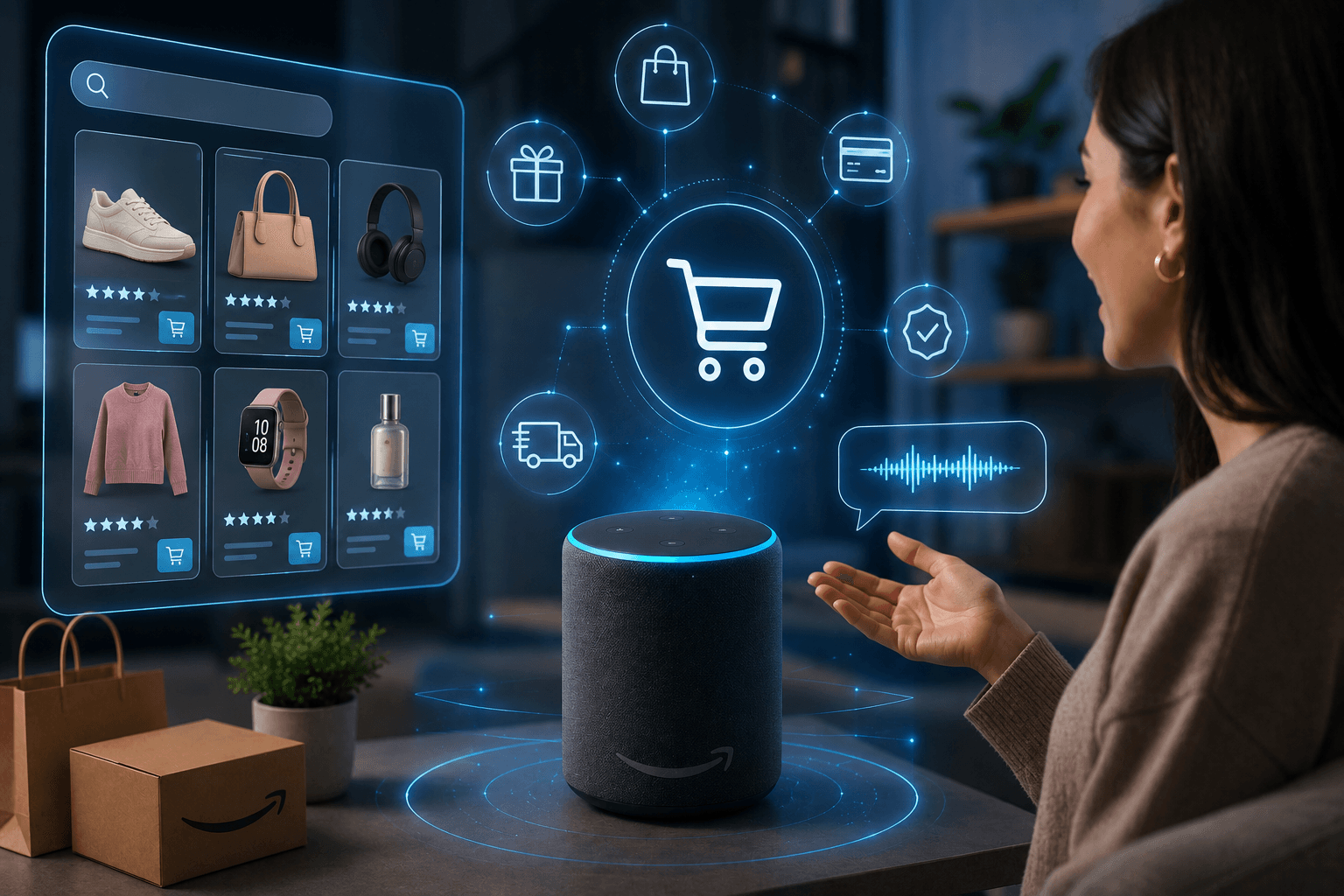
Amazon Web Services has opened up the technology powering its own market-leading Alexa for Shopping assistant to retailers worldwide. Announced on 27 May 2026, the Agentic Shopping Assistant (ASA) on AWS lets any brand deploy a brand-native, conversational AI shopping experience — backed by billions of real shopping interactions — in approximately 60 days, without starting from scratch.
From Amazon's Own Tech Stack to the Retail Industry
The launch follows Amazon's decision to rebrand its e-commerce chatbot Rufus — used by over 300 million customers in 2025 — and merge it with Alexa+ into a unified assistant called Alexa for Shopping. That consolidated product now sits directly inside Amazon's search experience and can compare items, track prices, reorder essentials, and shop across other websites.
The ASA on AWS packages the same architecture, learnings, and infrastructure behind that assistant and makes it available to outside retailers for the first time. Amazon describes itself as "Customer Zero" for AWS — meaning every component of the solution has already been stress-tested in one of the world's most demanding retail environments, validated through billions of real shopping interactions on Amazon.com.
What the Agentic Shopping Assistant Includes
The offering is managed by the AWS Generative AI Innovation Center, a global team that helps customers design, build, and launch AI solutions. What retailers receive is a complete package: architecture guidance, starter code, customisation to brand tone, catalogue logic, and user journeys — plus hands-on support from AWS experts and system integrator partners.
Each deployment is built on Amazon Bedrock, AgentCore, and OpenSearch, and is fully customised to each retailer's specific catalogue, customer base, shopping environment, and brand voice. The goal is a brand-native assistant — not a generic FAQ bot that recites static answers — that can surface personalised recommendations through natural conversation.
The business case for conversational AI in retail is compelling: conversational shopping sessions convert at 3.5 times the rate of traditional keyword search, according to AWS. Amazon's own AI shopping assistant drove nearly $12 billion in incremental sales for the company in 2025 alone.
Kate Spade: The First Retailer to Go Live
Kate Spade, part of the Tapestry portfolio, became the first production-ready retailer to deploy the solution. On 13 April 2026, it launched the Kate Spade AI Gift Concierge, built with Amazon Bedrock AgentCore and purpose-built for a high-stress shopping moment: gift buying.
With research showing that 53% of shoppers report stress during gift purchases, the concierge engages users in natural dialogue about the occasion, recipient, and style preferences — translating uncertain intent into curated, confident product recommendations. The experience was informed by real shopper behaviour drawn from millions of questions asked through Alexa for Shopping. The assistant runs on Anthropic's Haiku 4.5 model, with Amazon Bedrock providing observability, authentication, and evaluations. The team completed approximately 2.5 months of rigorous testing before going customer-facing.
"We are excited about the possibilities agentic commerce can bring to our customers. AWS brought the recipe, but together we built the customisation our consumers needed."— Yang Lu, Chief Information & Digital Officer, Tapestry
What This Means for the Broader Retail AI Race
The move is significant for the broader competitive landscape of agentic commerce. Amazon has long followed a pattern of turning internal infrastructure — logistics, cloud, AI — into commercial services sold to the wider market. The ASA on AWS is the latest example: technology built to solve Amazon's own retail problems, now offered as a product.
Crucially, the solution is delivered through AWS rather than Amazon's marketplace, which may help ease concerns from retailers wary of sharing data with a direct competitor. The structure keeps the customer relationship in the retailer's hands, while AWS provides the underlying AI backbone. Additional retailers are already in testing, signalling that the rollout is expected to accelerate throughout 2026.