
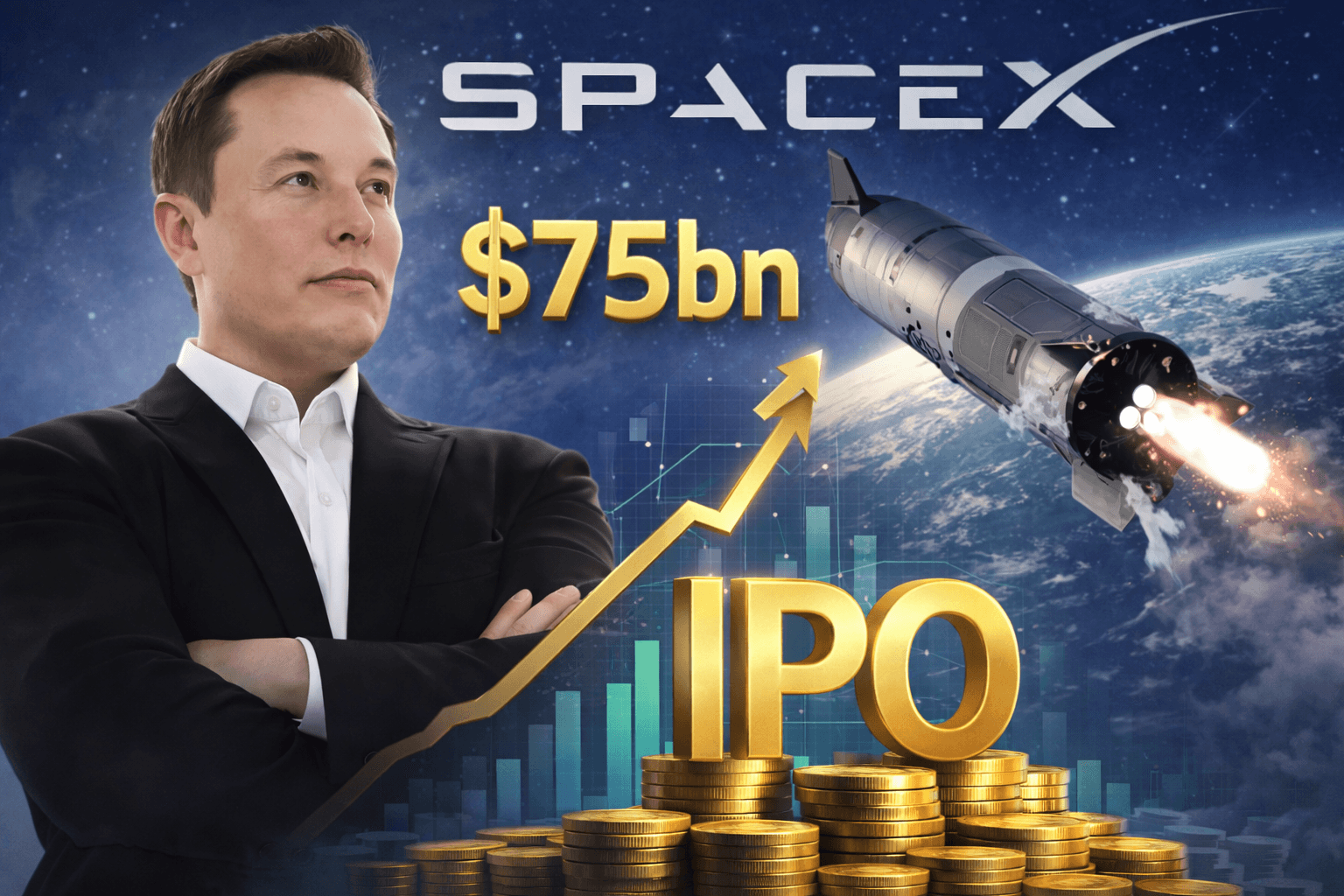
Ready to Launch: SpaceX and Elon Musk's US$75bn IPO Plans
AI / Machine Learning | 5 min read
SpaceX is preparing for what could be the most significant IPO in financial history. Reports across major financial outlets indicate that Elon Musk's aerospace and technology conglomerate is targeting a US$75 billion capital raise at a total valuation of US$1.75 trillion — eclipsing Saudi Aramco's previous record of US$29.4 billion set in 2019 by an enormous margin. Investor briefings are expected to begin in April 2026, with the company targeting a public market debut in June 2026. If realised, SpaceX would become the first company in history to go public at a valuation exceeding US$1 trillion — immediately more valuable than Meta, ExxonMobil, or Walmart.
What SpaceX Is Today: Rockets, Satellites, and AI Under One Roof
The SpaceX going public is not just a rocket company. In February 2026, SpaceX completed the absorption of X (formerly Twitter) and xAI — Musk's artificial intelligence venture behind the Grok chatbot — creating a vertically integrated conglomerate that combines orbital launch services, a global satellite internet network, and large-scale AI compute capabilities. The xAI unit alone was valued at US$250 billion at the time of the all-stock merger. The combined entity is now positioning itself to Wall Street as an "Orbital Intelligence" utility: owning the heavy-lift infrastructure to reach space (Starship), the global digital infrastructure of the future (Starlink), and the AI capabilities to run it (xAI/Grok). The FAA's January 2026 approval for up to 44 annual Starship launches provided the regulatory certainty needed to underpin the public valuation.
Starlink: The Revenue Engine
At the core of the IPO's financial case is Starlink, which had surpassed 9.2 million active subscribers by early 2026 and is projected to generate between US$20 billion and US$24 billion in revenue in 2026 — with reported profits of over US$8 billion in 2025. SpaceX's overall revenue reached approximately US$16 billion in 2025, with the combined entity expected to exceed US$20 billion. The IPO filing is expected to be confidential initially, with full financials disclosed ahead of the roadshow — meaning Wall Street is currently pricing on projections rather than audited results.
Doing Things Differently: The IPO Structure
SpaceX is approaching the IPO process in a distinctly unconventional manner across several dimensions:
- • 30% retail allocation — three times the Wall Street standard — specifically designed to create a loyal long-term shareholder base, with priority reportedly being offered to existing Tesla shareholders. Bank of America has been handpicked by Musk as lead underwriter to manage the US retail allocation; Mizuho (Japan), Barclays (UK), and Deutsche Bank (Germany) are handling overseas retail investors
- • Only ~5% of equity floated — a fraction of the typical IPO float. Nasdaq is reportedly considering dropping its rule requiring at least 10% of shares to be offered publicly to accommodate this structure. Both Nasdaq and NYSE have proposed "fast-track" routes that would allow SpaceX to join major indices such as the Nasdaq 100 in as little as 15 days after listing — compared to the usual one-year wait
- • Dual-class share structure — insiders including Musk will retain strong voting control after the IPO. Musk currently holds approximately 42% voting control and roughly 54% economic stake in SpaceX
- • Staggered lock-up and potential day-one selling — SpaceX is reportedly considering allowing some existing shareholders to sell positions on day one, a bold signal of confidence in demand. Extended lock-ups of six months or more are being designed to prevent mass sell-offs from early investors
The Broader Stakes: AI, Orbital Data Centres, and a New Space Economy
Beyond the financial mechanics, the IPO represents a defining bet on several converging technology frontiers. The capital raised is expected to fund the continued development of the Starship rocket (targeting Moon and Mars missions), the build-out of xAI's AI training infrastructure (estimated to be spending close to US$1 billion per month), and Musk's stated vision of placing one million orbital data centres in space — powered by direct solar energy and cooled by the vacuum of space, without the terrestrial grid constraints plaguing Earth-based AI infrastructure. The news of the IPO triggered an immediate "SpaceX halo effect" across the space sector, with Rocket Lab's stock jumping 8% in early trading on the announcement.
Key Takeaways
- • SpaceX is targeting a US$75 billion capital raise at a US$1.75 trillion valuation — the largest IPO in history, dwarfing Saudi Aramco's previous record of US$29.4 billion. A June 2026 public debut is the target, with investor briefings expected in April.
- • The SpaceX going public is a vertically integrated conglomerate — following the February 2026 absorption of X and xAI (valued at US$250 billion) — combining launch services (Starship), global satellite internet (Starlink, 9.2M subscribers), and AI compute (Grok/xAI).
- • Key structural innovations: 30% retail allocation (3x the norm, with Tesla shareholder priority), only ~5% of equity floated, a dual-class share structure preserving Musk's control, and fast-track Nasdaq-100 index inclusion in as little as 15 days post-listing.
- • Starlink is the financial backbone — projected US$20–24 billion revenue in 2026, US$8 billion+ profit in 2025, with FAA approval for up to 44 annual Starship launches providing regulatory certainty for the valuation.
- • Capital will fund Starship development, xAI compute buildout (~US$1bn/month), and Musk's stated vision of one million orbital data centres — positioning SpaceX as the "highway to space" and the AI infrastructure provider of the next century.