
Tech Mahindra and the Future of Sustainable Enterprise Tech
AI / Machine Learning | 5 min read
As enterprises race to extract value from AI, a fundamental question is emerging: can the pursuit of AI-driven growth be reconciled with sustainability commitments? For Tech Mahindra, the answer is not just yes — it is the entire point. With a revenue of US$1.548 billion, Tech Mahindra has been embedding ESG intelligence into enterprise operations through automation and AI, positioning itself as both a practitioner and an enabler of sustainable technology transformation. Harshul Asnani, President and Head of Europe Business at Tech Mahindra, argues that 2026 is a defining moment — a year when organisations must stop asking what AI can do and start asking what they are willing to let go.
AI Requires Organisational Metabolism
"Organisations that are pulling ahead are redefining the way decisions are made and how accountability is distributed — it means a shift in organisational structure. AI requires organisational metabolism. Companies that stop thinking about what AI can do and instead start thinking what are we willing to let go — they will get ahead. 2026 is a moment of truth: you need a lot of nerve in leadership and should take the bull by the horns by redesigning the processes and the governance."
— Harshul Asnani, President and Head of Europe Business, Tech Mahindra
Asnani's framing of AI as requiring "organisational metabolism" cuts to the heart of where most enterprises are stuck. Having moved through the hype cycle and overcome initial human fear of the technology, organisations are now confronted with a harder challenge: structural change. The companies pulling ahead, he argues, are those redesigning functional workflows and governance — not those layering AI tools onto legacy processes.
From Implementers to Orchestrators: The SI Pivot
Asnani is equally candid about the challenge facing technology services companies themselves. Tech Mahindra's own business model is in the midst of transformation — from a traditional system integrator model to something closer to an orchestrator of enterprise AI adoption. He notes that 2025 will be the last financial year where the industry grows in lockstep with the number of people, with BPO and software development increasingly delivered by AI agents and digital colleagues. The pricing model is shifting accordingly — from transaction-based billing to revenue share and gainshare contracts linked directly to outcomes.
"In the past we did not charge customers for us to train humans — with agents we are charging to build and train them, but once they are fully deployed there is no charge. In this way we are bringing the automation and productivity to bring down the customer's cost. Once AI is adopted at scale, the technology intensity of every company will shift from an average of four percent revenue spend to 15–20% of revenue spend."
— Harshul Asnani, President and Head of Europe Business, Tech Mahindra
Embedding ESG Intelligence Into Enterprise Operations
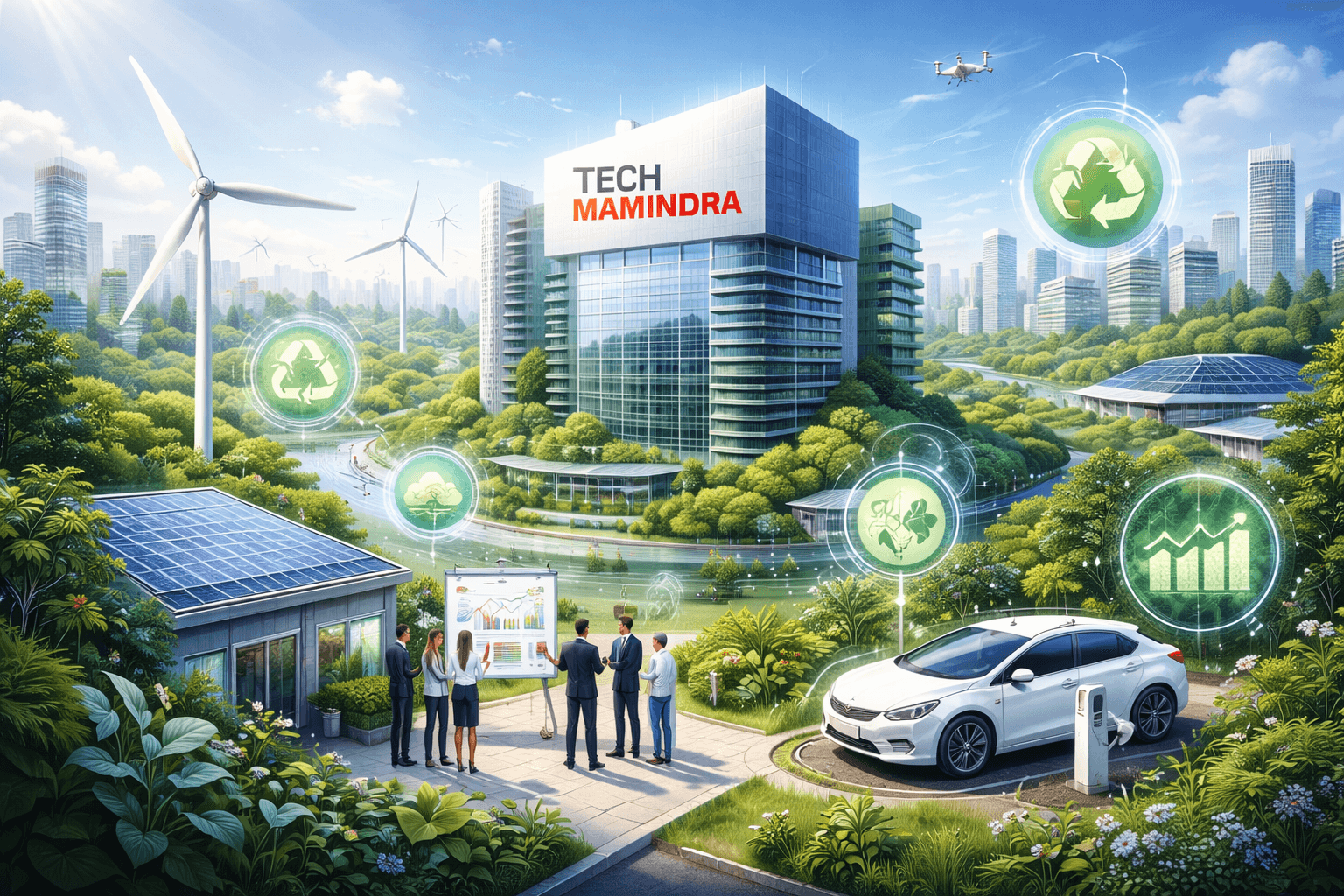
Beyond the AI transformation narrative, Tech Mahindra's sustainable enterprise strategy rests on a firm set of commitments and capabilities. The company's ESG and sustainability services help clients simplify compliance and reporting, accelerate Net Zero journeys with AI-driven insights, and implement Green IT and cloud strategies that produce measurable results. Tech Mahindra estimates that AI-driven solutions can reduce global GHG emissions by up to 4% by 2030. Its own sustainability targets include achieving net zero emissions by 2035, becoming 100% water positive by 2030, and reaching a 90% renewable energy mix by 2030.
The company has received external recognition for its approach — including an 'A' rating in MSCI ESG ratings, recognition as India's Most Sustainable Business of the Year 2025, Top Global IT Performer in the S&P Global Corporate Sustainability Assessment 2025, and membership in the top 5% of global sustainable companies on the S&P Global Yearbook 2025. It was also the first Indian company to receive the Sustainable Markets Initiative's Terra Carta Seal.
Key Partnerships Driving the Sustainable AI Agenda
Tech Mahindra's sustainable enterprise platform is built on a web of strategic partnerships. Recent collaborations include an agreement with AMD focusing on AI infrastructure and hybrid cloud deployments across manufacturing, finance, telecoms, and healthcare; a joint platform with ServiceNow using Gen AI for end-to-end enterprise service management; and initiatives with AWS using AI, generative AI, and ML to boost telecom network efficiency. The company's AI-driven payment automation system, launched at MWC 2026, automates payment support and collections while keeping employees in control of sensitive cases — a model of responsible agentic deployment in practice.
Key Takeaways
- • Tech Mahindra's Harshul Asnani frames 2026 as a moment of truth for AI adoption — the year organisations must stop asking what AI can do and start redesigning processes and governance to let it do it.
- • The SIs' business model is shifting from headcount-driven growth to outcome-based contracts — with revenue share and gainshare replacing transaction billing as AI agents take over BPO and software development.
- • Tech Mahindra projects technology spend shifting from ~4% of revenue to 15–20% at scale — and is repositioning itself from implementer to orchestrator to capture that shift.
- • Sustainability commitments include net zero by 2035, 90% renewable energy by 2030, 100% water positive by 2030, and the first Indian company to hold the Sustainable Markets Initiative Terra Carta Seal.
- • Key enterprise AI partnerships span AMD (AI infrastructure/hybrid cloud), ServiceNow (Gen AI E2E platform), AWS (telecom AI/ML), with responsible agentic AI in payments launched at MWC 2026.