
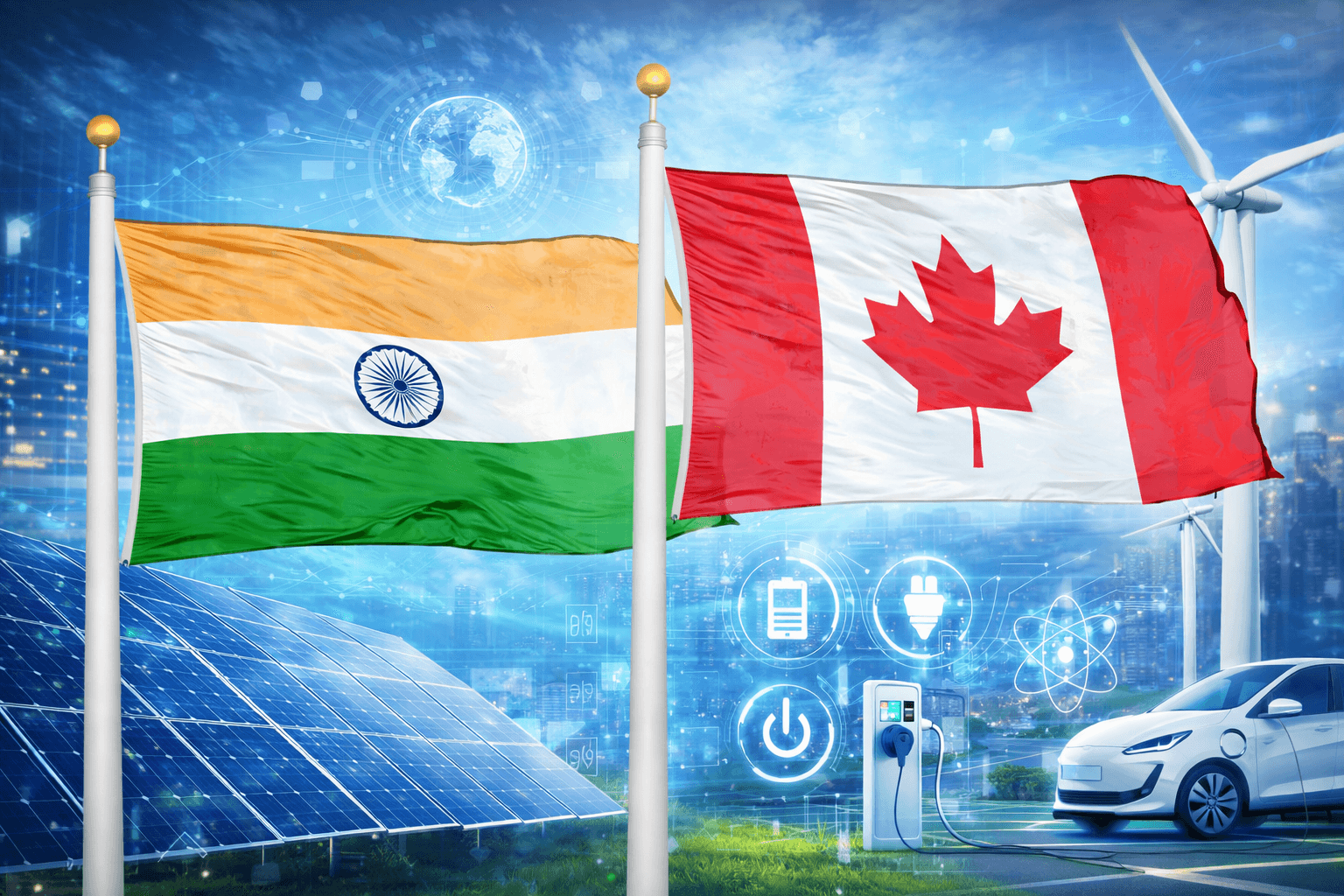
How the Canada–India Pact Is Supercharging Energy Tech
6 min read
Canadian Prime Minister Mark Carney's four-day visit to India in early March 2026 produced one of the most consequential bilateral technology and energy agreements either country has signed in decades. The centrepiece is a Strategic Energy Partnership spanning nuclear, LNG, LPG, hydrogen, renewables, critical minerals, and AI — underpinned by more than C$5.5 billion in commercial agreements and the formal launch of negotiations toward a Comprehensive Economic Partnership Agreement (CEPA) targeting bilateral trade of $50–70 billion by 2030.
A Diplomatic Reset with Strategic Timing
The agreement represents a meaningful reset after several years of strained diplomatic relations. Its timing is no accident. Geopolitical volatility — particularly the Iran war, the closure of the Strait of Hormuz, and escalating US trade tariffs — has sharpened both countries' appetite for diversified, politically stable energy partnerships. India, the world's third-largest oil consumer, fourth-largest LNG importer, and third-largest LPG consumer, is adding energy capacity faster than any other major economy. Canada, which has declared its ambition to become a global clean and conventional energy superpower, offers precisely the reliable long-term supply that India needs.
"In civil nuclear energy, we have reached a landmark deal for long-term uranium supply. We will also work together on small modular reactors and advanced reactors. India and Canada are natural partners in technology and innovation."
— Prime Minister Narendra Modi, joint press conference, New Delhi
The $2.6 Billion Uranium Deal: Nuclear at the Core
The anchor of the energy technology partnership is a landmark C$2.6 billion uranium supply agreement between Saskatchewan-based Cameco Corporation and India's Department of Atomic Energy — covering the supply of nearly 22 million pounds of uranium from 2027 to 2035. Beyond raw uranium supply, both leaders confirmed cooperation on Small Modular Reactors (SMRs) and advanced reactor technologies, signalling ambitions that extend from fuel supply into next-generation nuclear design and deployment.
Nuclear offers the low-carbon, baseload power that intermittent renewables alone cannot provide at the scale India requires — and a guaranteed long-term supply from a politically stable, AAA-rated partner significantly reduces the risk exposure that has historically complicated India's nuclear expansion plans.
The Full Energy Technology Stack: Six Pillars
The Strategic Energy Partnership extends well beyond nuclear. Six interconnected energy technology pillars define the scope of the cooperation:
- LNG and LPG — Canada's emerging west coast LNG export capacity is positioned as a long-term alternative to Middle Eastern supply. The Iran war and Hormuz disruption have lent urgency to diversifying away from a single chokepoint.
- Renewables — An MoU covers bilateral technical cooperation across solar, wind, biomass, waste-to-energy, small hydropower, and energy storage. Canada is joining the International Solar Alliance and upgraded to full membership in the Global Biofuels Alliance.
- Hydrogen — Simon Fraser University and the Hydrogen Association of India signed an MoU to advance joint hydrogen research, innovation, and technology development targeting clean hydrogen solutions.
- Critical Minerals — An MoU covers exploration, mining, processing, and technical exchange in lithium, cobalt, nickel, and rare earth elements — supporting India's EV, battery, and semiconductor supply chains while reducing dependence on China for these strategically vital materials.
- Carbon Capture — Saskatchewan's Petroleum Technology Research Center and IIT Bombay's National Centre of Excellence in CCUS formalised research cooperation, adding decarbonisation technology to the partnership's conventional energy components.
- AI in the Energy Sector — Both governments explicitly identified artificial intelligence applications in energy as a cooperation priority — spanning energy system optimisation, grid intelligence, predictive maintenance, and AI-powered clean technology deployment.
AI, Supercomputing, and the McGill Centre of Excellence
Both leaders announced bilateral cooperation in supercomputing, AI, and semiconductors. The most concrete institutional outcome is the Jubilant Bhartia–McGill University MoU to establish a Centre of Excellence in AI and Research in India — built around an industry-relevant Master's programme training 200 top graduates per year for high-impact global careers in AI. The partnership also includes a new Canada–India Talent and Innovation Strategy built on 13 university partnerships, and an MoU enabling up to 300 fully-funded research internship placements for Indian students through Canada's Globalink programme.
The Strategic Picture: Why This Deal Matters Beyond Its Specifics
The partnership arrives at a moment of structural realignment in global energy geopolitics. The Iran conflict and Hormuz disruption have demonstrated the fragility of energy supply chains built on narrow geographic dependencies. Canada's $116 billion in accelerated energy and resource project investments, its AAA credit rating, the lowest net debt-to-GDP ratio in the G7, and the completion of the Trans Mountain Expansion collectively position it as one of the world's most credible energy export partners for the next decade.
For the global technology industry, the AI and critical minerals dimensions are arguably as significant as the energy flows themselves. India's critical minerals MoU creates a pathway for stable, China-independent sourcing of the materials that underpin every major technology supply chain — from semiconductors and data centre infrastructure to EV batteries and defence systems. The AI cooperation framework spanning energy applications, research institutions, and talent pipelines creates the human capital infrastructure needed to sustain long-term technology partnership at the scale both economies require.
With Canadian pension funds already having invested $100 billion in India — a figure highlighted by Prime Minister Modi as a sign of global confidence — and the CEPA targeting completion by end-2026, the foundations of a long-term strategic technology and energy alliance between two complementary democracies are now formally in place.
Key Takeaways
- Canada and India have signed a Strategic Energy Partnership covering nuclear, LNG, LPG, hydrogen, renewables, critical minerals, carbon capture, and AI — anchored by C$5.5B+ in commercial agreements.
- A C$2.6 billion Cameco uranium supply deal covers nearly 22 million pounds to India from 2027–2035, with further SMR and advanced reactor cooperation confirmed.
- Critical minerals MoU covers lithium, cobalt, nickel, and rare earths — supporting India's EV, battery, and semiconductor supply chains while reducing China dependence.
- AI cooperation spans energy sector applications, a McGill–Jubilant Bhartia Centre of Excellence training 200 AI graduates annually, and a 13-university Canada–India Talent and Innovation Strategy.
- CEPA negotiations are targeted for completion by end-2026 with bilateral trade ambitions of $50–70 billion by 2030, backed by $100 billion in Canadian pension fund investment already in India.