
50 Years of Apple: From a California Garage to a Global Technology Giant
AI / AI Tech Trends | 5 min read
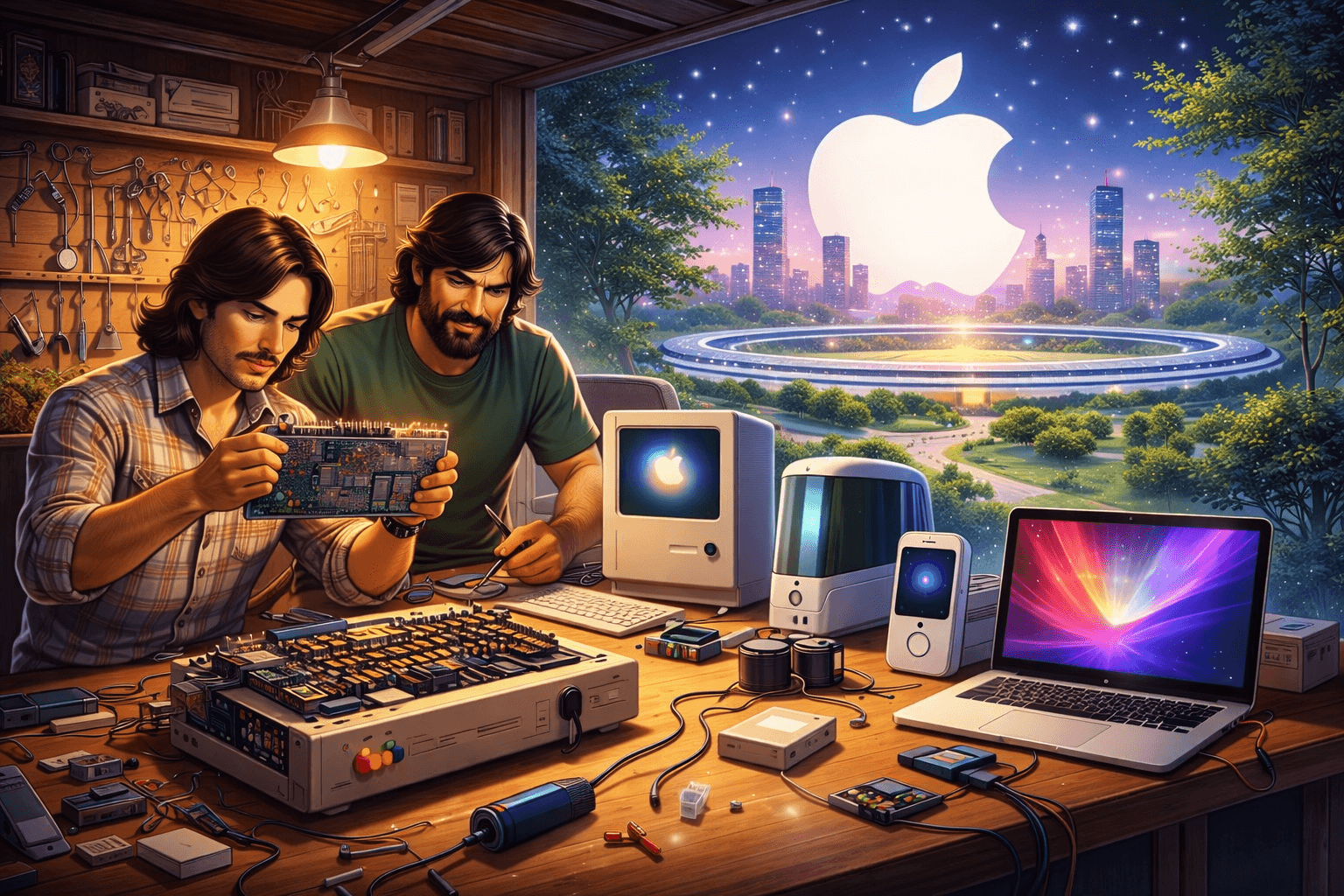
On 1 April 2026, Apple marked its 50th anniversary — five decades since Steve Jobs and Steve Wozniak signed a two-page partnership agreement on April Fool's Day 1976, creating Apple Computer Co. in a suburban Los Altos garage. What began as a radical idea — that powerful computing should be personal rather than locked inside corporate or government mainframes — has become one of the most consequential journeys in commercial history. Apple is now valued at approximately $3.5 trillion, supports billions of users worldwide across a tightly integrated ecosystem of hardware, software, and services, and enters its second half-century navigating the most significant technological shift since the smartphone: the AI era. As CEO Tim Cook noted to mark the milestone, Apple is more focused on building tomorrow than remembering yesterday — but the anniversary is nonetheless a remarkable moment to map how far the company has travelled.
"At Apple, we're more focused on building tomorrow than remembering yesterday. But we couldn't let this milestone pass without thanking the millions of people who make Apple what it is today — our incredible teams around the world, our developer community and every customer who has joined us on this journey."
— Tim Cook, CEO, Apple
The Origin: A Garage, a Circuit Board, and a Missed Opportunity
Apple was founded on 1 April 1976 by Steve Jobs (21, a college dropout with a vision), Steve Wozniak (25, an engineer with a gift for building electronics), and Ron Wayne — a more experienced adviser who took a 10% stake in the fledgling company. Wayne sold his share for $2,300 within days, amid early financial uncertainty — a decision now widely regarded as one of the most costly missed opportunities in corporate history. The company's earliest products — the Apple I and Apple II — brought colour graphics, expansion slots, and approachable design into homes, schools, and small businesses, turning the then-radical notion of the personal computer into a real and growing product category. By 1980, Apple's rapid growth culminated in a highly successful IPO, creating millionaires from early investors and cementing the company's status as one of the era's most promising technology firms.
Reinvention, Near-Bankruptcy, and the Return of Jobs
The 1984 launch of the Macintosh — preceded by Ridley Scott's now-legendary Super Bowl advertisement inspired by George Orwell's Nineteen Eighty-Four — redefined both marketing and the cultural significance of technology products. But the Macintosh struggled commercially due to its high price, triggering a rift between Jobs and then-CEO John Sculley that ended with Jobs' departure from the company he had co-founded. The years that followed were marked by product proliferation, strategic drift, and declining relevance. By the mid-1990s, Apple was near bankruptcy. The return of Steve Jobs in 1997 — following Apple's acquisition of NeXT — was the turning point. Jobs radically simplified the product line and launched the iMac, stabilising the company's finances. The iPod (2001), the iTunes Store (2003), and above all the iPhone (2007) — which reshaped the global smartphone industry with its touchscreen interface, app ecosystem, and user-focused design — established Apple as a category-defining force across consecutive technology waves.
The Next 50 Years: Services, AI, and the Question of Reinvention
As Apple enters its second half-century, its strategy has shifted — deliberately — away from pure hardware dependency toward a model sustained by deep brand loyalty and a sprawling ecosystem of integrated services. Its internal chip design programme (Apple Silicon) and continuous software investment deepen the brand's presence in customers' daily lives, while its corporate framing increasingly emphasises environmental sustainability, education, and global community impact as core strategic benchmarks. On AI specifically, Apple's advantage is argued to lie less in large public-facing chatbots and more in quiet, on-device intelligence: Apple Silicon chips and software tuned for private, low-latency AI features in photos, search, health, and productivity — making devices that learn how to talk to users rather than forcing users to adapt to machines. Whether that measured approach is sufficient against more aggressive AI rivals — including OpenAI — is now one of Apple's central strategic questions heading into its next chapter. The Computer History Museum in Mountain View, California, is running an "Apple@50" exhibition from 11 March through 7 September 2026, displaying rare prototypes including the Apple I, Lisa, Newton, and early iPhone models.
Key Takeaways
- • Apple turned 50 on 1 April 2026 — founded by Steve Jobs, Steve Wozniak, and Ron Wayne in a Los Altos garage on 1 April 1976 with a two-page partnership agreement and the radical conviction that powerful computing should be personal. Ron Wayne sold his 10% stake for $2,300; Apple is now valued at approximately $3.5 trillion.
- • The 50-year arc spans category-defining products across five consecutive technology waves: personal computing (Apple I, Apple II, Macintosh 1984); digital media (iPod 2001, iTunes Store 2003); smartphones (iPhone 2007); tablets (iPad 2010); and now AI-integrated devices and services — each reshaping consumer expectations for the industry that followed.
- • Apple's near-bankruptcy in the mid-1990s and Steve Jobs' return in 1997 (following the NeXT acquisition) is the central resilience narrative of the company's history — demonstrating how radical product line simplification and design-led focus can reverse existential decline and rebuild competitive advantage from near-zero.
- • Apple enters its second half-century shifting strategy from hardware dependency toward a services-and-ecosystem model — underpinned by Apple Silicon chip design and software integration — with its AI strategy focused on private, on-device intelligence (Apple Intelligence) rather than public-facing AI chatbots, prioritising user privacy and low-latency personalisation.
- • The 50th anniversary is being marked by a Paul McCartney performance at an Apple celebration in California, the Computer History Museum's Apple@50 exhibition (11 March–7 September 2026, rare prototypes including Apple I, Lisa, Newton, early iPhone), and a sold-out launch event featuring co-founder Ron Wayne (now 92) — while Tim Cook frames the milestone as a moment to thank teams, developers, and customers rather than reflect backward.